

Quick answer: Parks Medical ultrasonic Doppler flow detectors are simple, durable instruments, and most problems come from the probe, the battery or the audio path. Cracked probe faces, damaged cables, mismatched probe frequencies, worn sealed lead-acid batteries and failing headphone jacks or volume controls are the issues that come up most often.
This guide covers the 811-B, 811-BL, 811-BTS and 915-BL for hospitals, surgery centers and veterinary clinics.
Parks Doppler Models and How They Differ
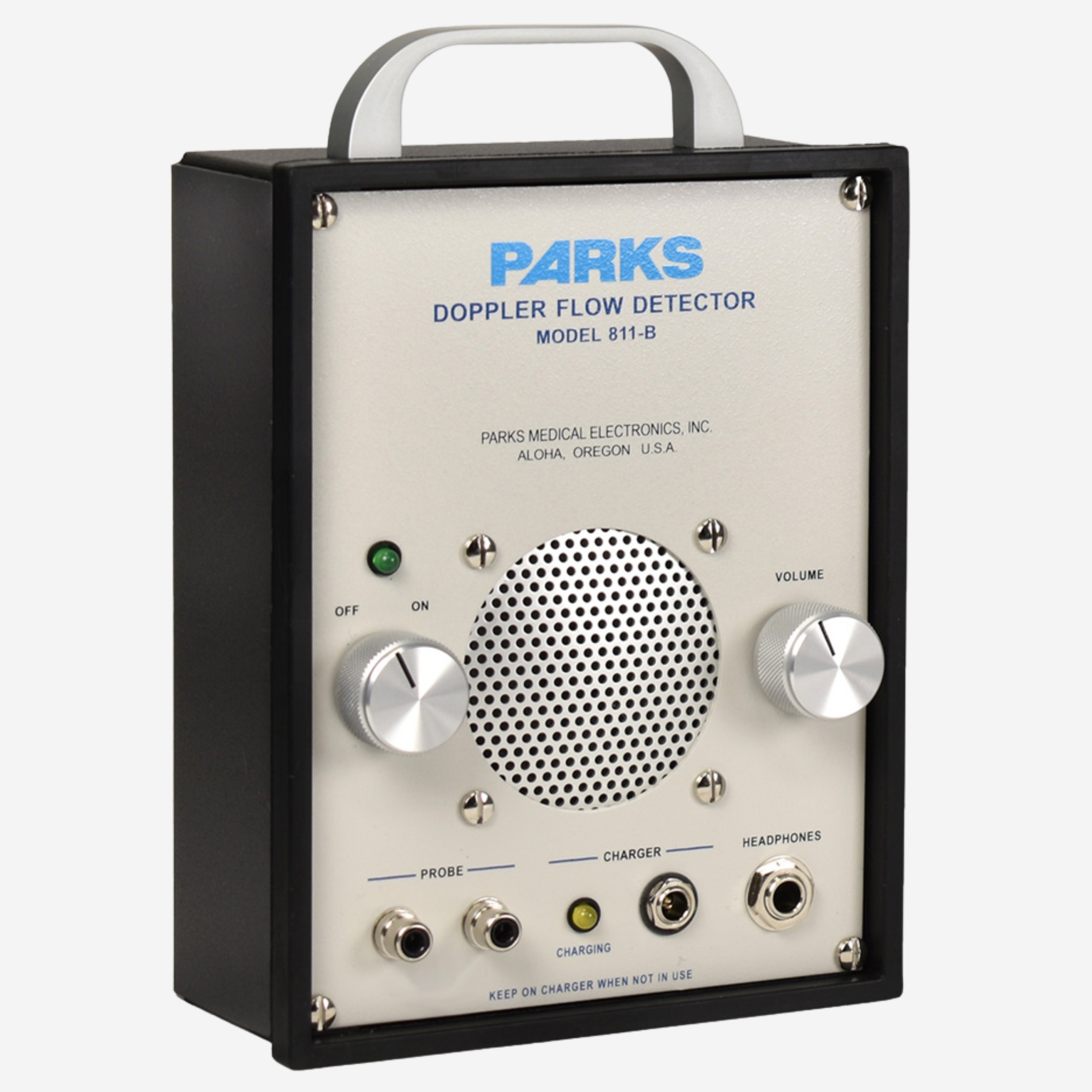
The 811-B, 811-BL and 811-BTS are non-directional Doppler flow detectors that use 8 to 9 MHz probes for systolic blood pressure and arterial flow detection. They share one platform and differ by a single feature. The 915-BL is a dual-frequency model built for surgical and anesthesia use.
- 811-B: the base model, with a built-in speaker, headphone jack and rechargeable battery
- 811-BL: adds a built-in cautery suppressor that filters electrosurgical interference
- 811-BTS: adds an automatic shutoff after a period of inactivity
- 915-BL: two channels in one case, a roughly 2.25 MHz precordial channel for air emboli and a high-frequency arterial channel, with an adjustable cautery suppressor
These models are intended for vascular use, not obstetrics. Parks builds its Dopplers to order in Aloha, Oregon, and veterinary clinics use them widely for blood pressure measurement.
Probe Frequency Matching
Every Parks probe is built for a specific frequency, and it must match the Doppler’s tuned frequency within 0.1 MHz. A mismatched probe produces heavy static and an unreliable signal even when nothing is broken. The tuned frequency is labeled on the panel next to the probe jacks and on the unit’s bar code label.
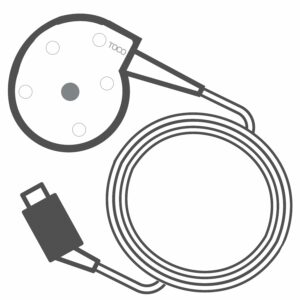
Probe styles include standard pencil, skinny pencil, adult flat and infant flat. Flat probes are designed to be taped in place for repeated measurements, and the flat probe is the style most commonly used on animals.
1. Damaged Probe Crystals and Probe Faces
A probe with a cracked or worn face gives a weak signal, no signal or intermittent static. The crystals sit under a protective epoxy covering, and once that covering is cracked or softened the probe loses sensitivity. Damaged epoxy can also let gel inside, which creates a shock or burn hazard.
Why it happens
Alcohol softens the crystal covering, and Parks states that alcohol destroys probes. Scraping off dried gel, autoclaving, ECG paste used as a contact medium and drops onto hard floors also damage the face.
How to avoid it
Use ultrasonic gel, not ECG paste. Wipe gel off with a soft tissue after each use, soften dried gel with warm water and inspect the epoxy before every use. Keep a spare probe, because probes fail more often than units.
2. Probe Cable and Connector Damage
Static that comes and goes as the cable moves almost always means a damaged probe cable or worn connector. The cable carries a low-level signal inside internal shielding, and once that shielding breaks, noise gets in. Connectors also wear with repeated plugging and unplugging.
Why it happens
Pulling on the cable instead of the connector, wrapping the cable tightly around the unit and frequent disconnects are the usual causes. Tight bundling breaks the internal shielding.
How to avoid it
Leave the probe connected when you can, pull on the connector body only and coil the cable loosely. Double-shielded cables are available for areas with heavy electrical interference.
3. Battery Problems
Parks 811-series and 915-BL Dopplers run on a rechargeable 12-volt, 1.2 Ah sealed lead-acid battery. Short run time, a battery lamp that blinks soon after charging, or a unit that will not power on usually means the battery is worn out or the charger is not doing its job.
Why it happens
Sealed lead-acid batteries lose capacity with age and with repeated deep discharges. Units left on between patients drain completely, which is why the 811-BTS adds an automatic shutoff.
How to avoid it
Recharge after use and never store the unit discharged. Replace the battery if it is more than three years old or will not hold a charge. Remember the unit will not run while connected to the charger by design.
4. Speaker and Headphone Jack Faults
If the Doppler shows power but stays silent, check the headphone jack before assuming the speaker failed. The internal speaker disconnects automatically when headphones are plugged in, so a worn or bent jack can behave as if headphones are always inserted and leave the speaker silent.
Why it happens
Headphone plugs pulled out at an angle bend the jack contacts. Drops and fluid that enters the case can damage the speaker or its connections.
How to avoid it
Use the 32-ohm stereo headphones Parks specifies, insert and remove plugs straight, and keep the unit upright and dry. If the speaker stays silent with nothing plugged in, send the unit in.
5. Volume Control Problems and Noise
On Parks 811-series Dopplers the power switch and volume control share one knob. A worn control can cause crackling when turned, dead spots, sudden volume jumps or a unit that cuts out at certain positions. Noise that does not change with the probe or cable usually points to the control or internal electronics.
Why it happens
Control knobs wear with daily turning, and impacts can crack the knob or bend the shaft. Electrocautery also overwhelms the signal on models without a cautery suppressor.
How to avoid it
Turn the knob gently and avoid using it as a handle. In the OR, use the 811-BL or 915-BL, keep the cautery grounding plate properly connected and keep the Doppler off metal surfaces.
Parks Doppler Symptom Quick Guide
Use this table to narrow down a Doppler problem before you send the unit in. Many complaints turn out to be the probe, the probe frequency or the charger rather than the Doppler itself, so always test with a known-good probe of the correct frequency before deciding the unit needs repair.
| Symptom | Likely cause | What to try first |
|---|---|---|
| Constant static | Probe frequency mismatch | Compare probe and panel frequency labels |
| Static when cable moves | Damaged cable or worn connector | Try a known-good probe |
| Weak or no signal | Cracked probe face or old gel | Fresh ultrasonic gel; inspect epoxy |
| Will not run on charger | Normal safety feature | Unplug the charger |
| Short run time | Worn sealed lead-acid battery | Full recharge; replace if over three years old |
| Silent speaker | Faulty headphone jack or speaker | Insert and remove headphones; listen again |
| Crackling volume | Worn power/volume control | Send in for evaluation |
Probe Care Checklist
Probes are the most fragile part of any Parks Doppler and the most common reason for a failed exam. A few simple habits will extend probe life considerably, cut down on static complaints and keep your Doppler ready the next time someone needs a quick systolic pressure or pulse check.
- Use ultrasonic gel only, never ECG paste or cream
- Never clean or soak probes in alcohol, and never autoclave them
- Wipe gel off after every use and do not scrape dried gel
- Pull on the connector, not the cable, and coil cables loosely
- Check the frequency label before swapping probes between units
Repair, Replace or Buy Recertified?
Repairing a Parks Doppler usually makes sense, because the units are built to last and most faults are in replaceable parts such as batteries, jacks, controls and probes. Buying a recertified unit makes sense when you need a different model, such as an 811-BL for the OR, or a backup Doppler.
- IPR Medical sells Parks Dopplers, including recertified (refurbished) units, plus probes and batteries
- Recertified equipment carries a 6-month or 1-year warranty depending on model
- Every repair carries a 90-day warranty, and units are tested and cleaned before they ship
- See our repair services for vascular Dopplers and Doppler probes
Parks Doppler FAQ
Why is my Parks Doppler full of static?
The most common causes are a probe that does not match the unit’s tuned frequency, a damaged probe cable or worn connector, and electrocautery interference on models without a cautery suppressor. Check the frequency label next to the probe jack, try a known-good probe, and inspect the cable for kinks or cuts.
Why won’t my Parks Doppler work while it is charging?
That is a safety feature, not a fault. Parks 811-series and 915-BL Dopplers are designed not to operate while connected to the charger, which keeps line power away from the patient-contact probe circuit. Unplug the charger to use the Doppler.
Can I use any Parks probe with my Doppler?
Only if the frequency matches. The probe frequency must match the Doppler’s tuned frequency within 0.1 MHz, or the signal becomes noisy and unreliable. Probe styles such as pencil and flat can be interchanged on a unit, as long as the frequency matches the label next to the probe jacks.
How often should a Parks Doppler battery be replaced?
Replace the 12-volt sealed lead-acid battery when it is more than three years old or no longer holds an adequate charge. A battery lamp that blinks soon after a full charge, or a unit that dies mid-exam, are common signs the battery is near the end of its life.
Can I clean a Doppler probe with alcohol?
No. Parks warns that alcohol softens the protective covering over the probe crystals and destroys probes. Wipe gel off with a soft tissue after each use, soften dried gel with warm water instead of scraping it, and follow Parks’ current probe cleaning instructions for disinfection.
What is the difference between the 811-B, 811-BL and 811-BTS?
All three are non-directional 811-series Dopplers using 8 to 9 MHz probes. The 811-BL adds a built-in cautery suppressor for use around electrosurgical units. The 811-BTS adds an automatic shutoff that powers the unit down after a period of inactivity to save battery.
Need Your Parks Doppler Repaired?
IPR Medical repairs Parks Dopplers in-house, with a free evaluation within 1 to 2 business days and no charge until you approve the estimate. Request a free shipping label or call (855) 477-8866, Monday through Friday, 7:00 AM to 4:30 PM Pacific. Email cs@iprmed.com anytime.
All product and manufacturer names are trademarks of their respective owners and are used only to identify equipment. IPR Medical is an independent service organization and is not affiliated with or endorsed by these manufacturers.