

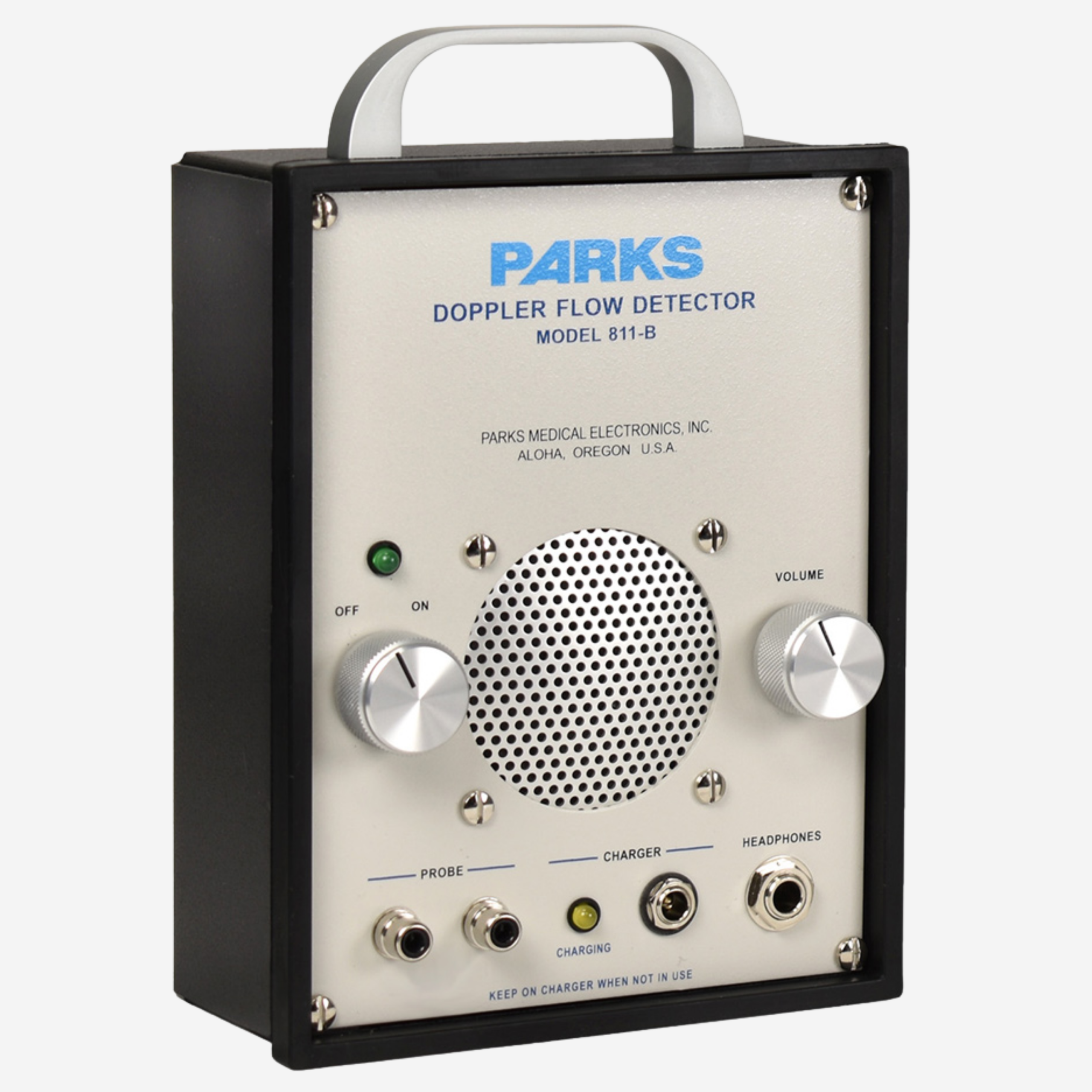


Parks Medical Ultrasonic Doppler Flow Detector 811-B
The Parks Medical Electronics Model 811-B is one of the most trusted non-directional Doppler flow detectors in clinical practice — a workhorse device that has been in continuous use for over 50 years. It uses a factory-tuned 8–9 MHz probe to detect blood flow acoustically, making it possible to measure systolic blood pressure at sites where a stethoscope cannot reach and to detect pulses too faint for conventional auscultation. Whether you’re measuring ankle-brachial pressures, monitoring peripheral arterial flow intraoperatively, or conducting a quick vascular screen at bedside, the 811-B delivers reliable signal with minimal setup. It’s used widely in operating rooms, emergency departments, recovery rooms, ICUs, vascular clinics, urology, pediatrics, and veterinary practice.
The internal speaker provides immediate audio feedback, and an auxiliary headphone jack allows for private monitoring or recording. Probe options include standard pencil, skinny pencil (for small vessels), adult flat, and infant flat configurations — the infant flat probe is the most commonly used probe in veterinary applications. Parks manufactures the 811-B in the USA at their facility in Aloha, Oregon, and the device carries a one-year warranty on the unit and six months on probes.
IPR Medical is an authorized Parks Medical Doppler repair facility and one of only a few such centers in the country. Working closely with the Parks Medical technical team, IPR Medical buys, sells, repairs, and stocks genuine replacement parts for the Parks Medical 811-B Doppler — including batteries, probes, and chargers. Whether you need a factory-quality repair, a certified refurbished unit, or expert Parks Doppler service you can trust, contact IPR Medical at 855-477-8866 or cs@iprmed.com.
Dopplers are sold based on the frequency without the probe. Please let us know if you also need a probe with your doppler.
Parks Medical Electronics 811-B — Specifications
| Manufacturer | Parks Medical Electronics, Inc. — Aloha, OR, USA |
| Model | 811-B |
| Device Type | Non-directional ultrasonic Doppler flow detector — Class IIa active medical device |
| Intended Use | Vascular studies — blood flow detection and systolic blood pressure measurement; not intended for obstetrical use |
| Probe Frequency Range | 8–9 MHz nominal; factory tuned to 8.2 MHz. Higher frequencies (toward 9 MHz) improve resolution for superficial vessels; lower frequencies (toward 8 MHz) penetrate deeper tissue more effectively. Probe and Doppler unit frequencies must match within 0.1 MHz — mismatched frequencies produce excessive static and unreliable signal (per Parks Medical technical team). |
| Compatible Probe Types | Standard Pencil (9.5 mm / ⅜ in diameter); Skinny Pencil (6.35 mm / ¼ in diameter); Adult Flat (15.9 mm × 19 mm); Infant Flat (12.7 mm × 15.9 mm) — infant flat is the most commonly used probe in veterinary applications |
| Standard Probe Cable Length | 1.5 m (5 ft) standard; 2.1 m (7 ft) and 3.0 m (10 ft) available by special order |
| Audio Output | Built-in internal speaker; auxiliary headphone jack (32-ohm stereo headphones); speaker disconnects when headphones plugged in |
| Power Source | Rechargeable 12V, 1.2 Ah sealed lead-acid battery (Parks Part # 854-0017-01); shipped fully charged and ready to use |
| Battery Charger | 24V, 0.63A (domestic); 24V, 0.625A with international socket adaptors (international units); cannot overcharge battery; safety circuit prevents operation during charging |
| Battery Status Indicators | Battery indicator lamp on when unit is powered; lamp blinks when battery needs charging. Fully charged: ~14.5V; needs charging: ~11.3V; fails: ~10V |
| Operating Temperature | 50°F to 104°F (10°C to 40°C) |
| Operating Humidity | 30% to 75% relative humidity |
| Operating Atmospheric Pressure | 700 hPa to 1060 hPa |
| Storage / Transport Temperature | -40°F to 158°F (-40°C to 70°C) |
| Ingress Protection | IPX0 — no water ingress protection; avoid fluid contact with unit |
| Electrical Safety Classification | Type B Applied Part per IEC 60601-1; Class IIa active medical device |
| Standards Compliance | IEC 60601-1; IEC 60601-1-2; IEC 60601-1-4; IEC 60601-1-6; IEC 60601-2-37; EN14971; EN10993-1; CE marked (Class IIa) |
| Country of Manufacture | USA (Aloha, OR) |
| Authorized Repair | IPR Medical is an authorized, approved Parks Medical Doppler repair facility — one of the few in the country. Send your 811-B to IPR Medical for factory-quality service and expert repairs backed by a direct relationship with the Parks Medical technical team. |
| FDA Device Corrections | Class 3 correction on record (2007) for select serial numbers — premature battery failure due to manufacturing issue. See the Description tab for details and FDA resources. |
IPR Medical is an authorized Parks Medical Doppler repair facility. We buy, sell, repair, and stock genuine parts for the Parks Medical 811-B. Contact us at 855-477-8866 or cs@iprmed.com.
Trademark Notice: Parks Medical, and all other brand names, model names, and part numbers shown are trademarks of their respective owners and are used on this page only to identify the original manufacturer’s equipment offered here, consistent with nominative fair use. This listing is offered by IPR Medical, an ISO 9001:2015-certified independent service organization, and is not sponsored by, affiliated with, or endorsed by Parks Medical.
Overview
The Parks Medical Electronics Model 811-B is a non-directional ultrasonic Doppler flow detector and the most widely recognized Doppler of its type in the world, having been in continuous clinical use for over 50 years. Manufactured entirely in the USA at Parks Medical’s facility in Aloha, Oregon, the 811-B is purpose-built for vascular studies and systolic blood pressure measurement — particularly in situations where a conventional stethoscope cannot reliably detect flow. It is suitable for adult and pediatric patients, and is equally at home in human clinical settings and veterinary practice. The device is not intended for obstetrical use; Parks Medical Electronics produces a separate line of obstetrical Dopplers for that application.
Clinical Applications
The 811-B’s 8–9 MHz probe frequency is optimized for detecting blood flow in peripheral vessels, including sites where conventional auscultation fails — faint distal pulses, post-occlusion pressure measurements, and low-amplitude flow states. The device is used extensively in operating rooms for intraoperative flow monitoring, in emergency and recovery rooms for rapid vascular assessment, in ICUs and surgical wards for ongoing monitoring, and in vascular, urology, and pediatric clinics for diagnostic studies. Systolic blood pressure is measured by combining the 811-B with an inflatable sphygmomanometer cuff; the Doppler substitutes for the stethoscope, and systolic pressure is read from the manometer gauge when flow first returns as cuff pressure is released. Veterinary applications follow the same principle, and the 811-B is frequently deployed for blood pressure screening and peripheral vascular assessment in animals of all sizes.
Probe Frequency: Rationale for Higher vs. Lower MHz
The 811-B operates across a probe frequency range of 8 to 9 MHz. Within this range, frequency selection is a trade-off between resolution and depth of penetration. Higher frequencies — toward the 9 MHz end of the range — produce a shorter ultrasound wavelength that improves signal clarity and resolution for superficial vessels close to the skin surface, such as the radial artery, pedal vessels, and small peripheral arteries. Lower frequencies within the range — closer to 8 MHz — have a longer wavelength that penetrates deeper tissue more effectively, making them better suited for vessels located further below the skin surface.
A critical compatibility requirement: the probe frequency and the Doppler unit’s tuned frequency must match within 0.1 MHz of each other. According to the Parks Medical technical team, a frequency mismatch beyond this tolerance will result in excessive static and an unreliable signal, making accurate flow detection impossible. The tuned frequency of a given 811-B unit is labeled on the panel next to the probe jacks and on the bar code label attached to the unit. Always verify that any replacement or spare probe matches the tuned frequency of the specific Doppler unit it will be used with before purchase. If you are unsure of your unit’s tuned frequency or need help selecting a compatible probe, contact IPR Medical — as an authorized Parks Medical Doppler repair and service facility, our team works directly with Parks Medical and can help identify the correct probe for your specific unit.
Probe Options and Veterinary Use
Four probe styles are available for the 811-B, all requiring frequency matching to the unit. The standard pencil probe (9.5 mm diameter) is the most common choice for routine peripheral vascular assessment and blood pressure measurement in human patients. The skinny pencil probe (6.35 mm diameter) concentrates the ultrasound beam with higher intensity for better resolution when targeting small or deep vessels. Flat probes are designed to be taped in place for repeated measurements at a fixed anatomical site; their crystals are angled at approximately 15 degrees from perpendicular to optimize the Doppler signal angle. The adult flat probe measures 15.9 mm × 19 mm, while the infant flat probe measures 12.7 mm × 15.9 mm. The infant flat probe is the most commonly used configuration in veterinary practice, as its smaller footprint conforms well to the limbs and pressure measurement sites of companion animals and small patients. Probe cables are 1.5 m (5 ft) as standard, with 2.1 m and 3.0 m lengths available by special order. Double-shielded cables are also available for environments with elevated electromagnetic interference. Parks recommends always keeping a spare probe on hand, as probes fail more often than the Doppler unit itself.
Power, Audio, and Controls
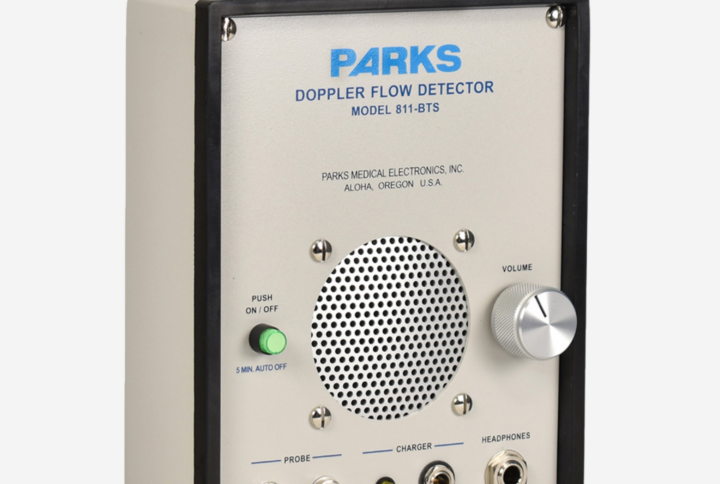
The 811-B runs on a rechargeable 12V, 1.2 Ah sealed lead-acid battery and ships fully charged and ready for immediate use. The battery indicator lamp lights when the unit is on and blinks when charging is needed. The charger output is 24V at 0.63A and is designed to prevent overcharging. A critical safety feature prevents the unit from operating while connected to the charger, eliminating the risk of electrical shock through the patient-contacting probe circuit. The battery should be replaced if it is more than three years old or no longer holds an adequate charge. The front panel provides a power/volume control knob, two probe jacks (either connector orientation is accepted), a battery charger jack, a headphone jack, and the built-in speaker. The internal speaker delivers real-time Doppler audio and disconnects automatically when 32-ohm stereo headphones are plugged into the auxiliary jack, enabling private monitoring or audio recording.
Electrical Safety and Use Precautions
The 811-B is classified as a Type B Applied Part under IEC 60601-1, and all patient-contacting accessories comply with the relevant directives for protection against electrical shock. The instrument must not be used with a defibrillator, as the probe can transmit electric shock or cause burns in that configuration. During electrocautery procedures, the cautery grounding plate must be properly connected and the Doppler unit should be suspended from an insulator rather than placed on a metal surface. The unit must not be used in the presence of flammable anesthetic gases or high-oxygen environments. The probe’s epoxy covering should be inspected before each use for cracks or breaks — damaged epoxy can allow coupling gel ingress that creates a shock or burn hazard if the unit is grounded. Any proposed connection of the 811-B to external equipment such as computers or amplifiers requires a medical-grade isolation transformer and review by a qualified bioengineer.
FDA Device Corrections and Safety Bulletins
A Class 3 FDA device correction was recorded for the Parks Medical 811-B (and related 811-BTS and 811-BL models) in 2007. The correction was initiated on September 28, 2007, and involved a limited set of serial numbers distributed primarily in the USA, Canada, and Australia. The identified issue was premature battery failure caused by the use of incorrect acid flux on the circuit board during manufacturing, which could lead to degradation of the sealed lead-acid battery earlier than expected. The FDA classified this as a Class 3 correction — the least serious category, meaning the FDA determined that use of or exposure to the affected product was not likely to cause adverse health consequences. Parks Medical Electronics notified affected customers directly. Because FDA device corrections and safety communications may be updated or expanded after the date of this listing, IPR Medical recommends that facilities also check the FDA’s official resources directly to ensure they have the most current information.
FDA resources for the most current correction and recall information:
– FDA Medical Device Recalls Database
– FDA Medical Device Safety
IPR Medical — Authorized Parks Medical Doppler Repair & Service
IPR Medical is an authorized, approved Parks Medical Doppler repair facility and one of the few such centers in the United States. Working directly with the Parks Medical technical team, IPR Medical provides factory-quality repair and service for the 811-B and the broader Parks Medical Doppler product line. Whether your unit needs a battery replacement, probe replacement, electronic repair, or full bench service, IPR Medical’s technicians are trained and equipped to restore your Parks Doppler to proper operating condition using genuine Parks Medical parts. IPR Medical also buys and sells new and refurbished Parks Medical 811-B units and stocks genuine replacement components — including batteries, probes, chargers, and carrying cases — so you can source your Parks Doppler equipment and service from a single trusted partner.
IPR Medical is an authorized Parks Medical Doppler repair facility. We buy, sell, repair, and stock genuine parts for the Parks Medical 811-B. Contact us at 855-477-8866 or cs@iprmed.com.
Trademark Notice: Parks Medical, and all other brand names, model names, and part numbers shown are trademarks of their respective owners and are used on this page only to identify the original manufacturer’s equipment offered here, consistent with nominative fair use. This listing is offered by IPR Medical, an ISO 9001:2015-certified independent service organization, and is not sponsored by, affiliated with, or endorsed by Parks Medical.
| Weight | 2 lbs |
|---|---|
| Dimensions | 8 × 6 × 4 in |
| Frequency | 8.0 MHz, 8.1 MHz, 8.9 MHz, 9.0 MHz, 9.1 MHz, 9.3 MHz, 9.4 MHz, 9.8 MHz |
- AC Adapter/ Charger
- Flat Probe
- Standard Pencil Probe
You may also like…
Parks Medical Ultrasonic Doppler Flow Detector 811-BTS
Original price was: $895.00.$795.00Current price is: $795.00.


Reviews
There are no reviews yet.