


Quick answer: Choose a veterinary infusion pump by how it fits your patients and supplies: IV set or syringe compatibility and calibration, flow rate range, bodyweight dosing and drug library support, portability and mounting, fluid warming, and who will service it. Compare categories first, then models within the category you need.
This guide is for practice owners, veterinarians, technicians and hospital managers comparing pumps.
IV Pump or Syringe Pump?
Most clinics need both types. A volumetric IV pump moves fluid from a bag through an administration set and handles maintenance fluids, larger volumes and transfusions. A syringe pump pushes a syringe plunger at a controlled rate and is better for small volumes, constant rate infusions and very small patients.
If your caseload includes cats, exotics or neonates, look closely at low-end flow rates on both pump types.
1. IV Set Compatibility and Calibration
A volumetric pump is only as accurate as its calibration to the IV set in use. Pumps are calibrated to specific administration sets, and running an uncalibrated set can deliver the wrong volume. Before you buy, confirm which sets the pump is calibrated for and whether those sets are easy to source.
Every IPR Medical IV pump calibrates to multiple IV set brands, and the SnipPET draws on a library of more than 200 supported sets. Clinics store profiles for the sets they stock and switch when a brand is backordered. IPR also stocks the SY0003 IV administration set and TS-V2 blood administration set for its IV pumps.
2. Flow Rate Range and Accuracy
Flow range determines which patients a pump can serve. A wide range covers both a small cat on a slow infusion and a large dog receiving fluid boluses. Syringe pumps usually reach lower rates, and their maximum rate depends on syringe size. Check the stated accuracy for each pump type you compare.
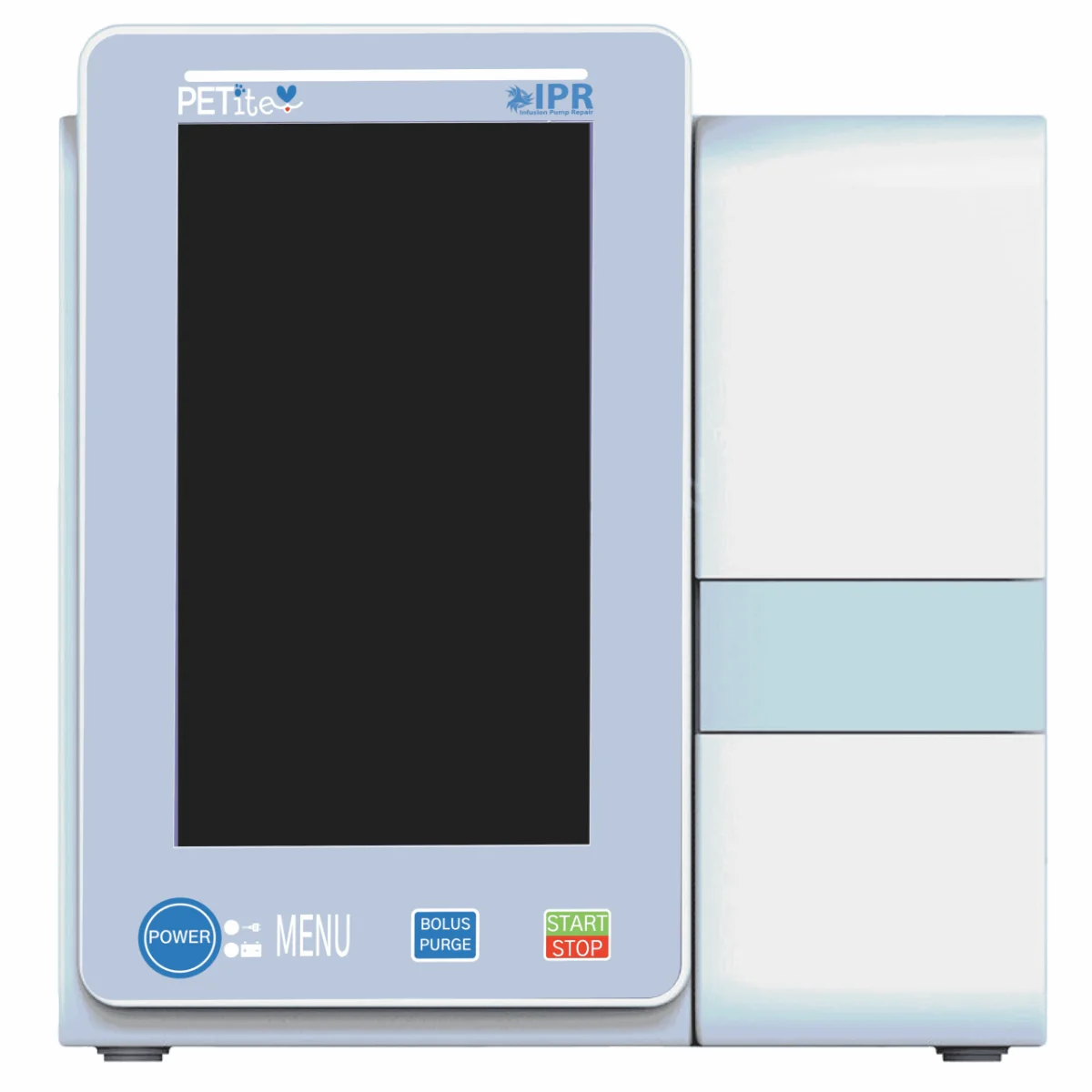
- PETite and SnipPET (IV): 0.10 to 2,000 ml/h
- PETfusion (syringe): from 0.01 ml/h, up to 1,500 ml/h with a 50/60 ml syringe, at ±2% system accuracy
- InfuPET (syringe): from 0.1 ml/h, up to 1,500 ml/h with a 50/60 ml syringe, at ±2% system accuracy
3. Drug Library and Bodyweight Dosing
Bodyweight dosing lets staff enter patient weight and drug concentration so the pump calculates the rate, which reduces manual math during busy shifts. A drug library adds preset drug profiles for guided programming. Look at both features, and at how many infusion modes the pump offers.
- PETite: six modes including Bodyweight, Drug Library, Micro and Sequence, with 2,000+ drug parameters
- SnipPET: ml/h, Bodyweight, Drip and Micro modes
- PETfusion: 2,000+ parameter drug library
- InfuPET: ml/h, body weight and loading dose modes with a 20-drug library
For questions about setting up or loading a drug library, contact us.
4. Portability and Mounting
Vet pumps move between exam rooms, surgery and kennels, so weight, battery life and mounting matter as much as features. Look for a pump that mounts where your patients are, whether that is an IV pole or a cage door, and that runs long enough on battery for procedures and recovery.
- PETite and PETite Heat: pole clamp, cage clip and carabiner eyelet; the PETite weighs 3.3 lb
- SnipPET: 3.3 lb with IP44 water resistance
- PETfusion and InfuPET: pole clamp included and 12-hour battery life at 5 ml/h
5. Fluid Warming
Warmed IV fluids help protect anesthetized, critically ill and small patients from heat loss. Many clinics add a separate warmer to the pole, but an integrated warmer saves space and setup time. If you warm fluids routinely, compare integrated designs with stand-alone warmers before you buy.
The PETite Heat warms fluid to an adjustable 86°F to 104°F with ±1.8°F control accuracy through a 43-inch heating tube, and shuts the heater off automatically above 122°F.
6. Service, Warranty and Support
Every pump eventually needs batteries, calibration and repairs, so ask who services it before you buy. Look for in-house repair, parts availability, calibration to your IV sets and a clear warranty. Ask how long evaluations take and whether you get a written estimate before any work.
- IPR Medical repairs veterinary pumps in-house; see our veterinary infusion pump repair page
- Every repair carries a 90-day warranty, and recertified equipment carries 6 months or 1 year depending on model
- A unit you decline to repair can be credited toward another pump
Comparing Pump Categories
The right category depends on your caseload, supplies and staff. This table compares the main options veterinary clinics consider, without prices, so you can narrow the field before looking at individual models. Many clinics end up with a mix: IV pumps for fluids and a syringe pump for CRIs.
| Category | Best for | Watch for |
|---|---|---|
| Veterinary IV pump | Fluids and transfusions with vet-friendly mounting | IV set calibration list |
| Veterinary IV pump with warmer | Surgery, critical care and small patients | Pole space and power |
| Veterinary syringe pump | CRIs, small volumes, exotics | Supported syringe brands and sizes |
| Recertified hospital IV pump | Clinics already using that platform | Dedicated sets and human drug libraries |
| Recertified hospital syringe pump | Small-volume infusions | Syringe compatibility and warranty |
IPR Medical’s Veterinary Pumps
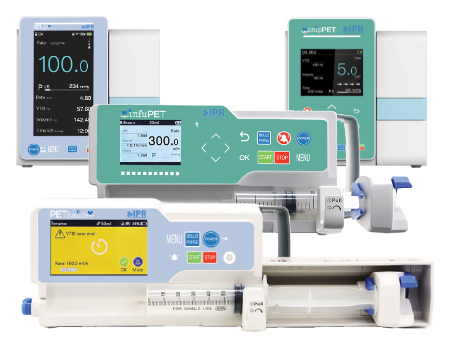
IPR Medical designs and sells five veterinary pumps, three IV pumps and two syringe pumps, in touchscreen and keypad versions. All five calibrate to multiple IV set or syringe brands, which protects clinics from single-brand supply shortages. Browse them on our veterinary pumps page.
- PETite (IPR210): touchscreen IV pump
- PETite Heat: PETite with integrated fluid warmer
- SnipPET (IPR110): non-touchscreen IV pump
- PETfusion: touchscreen syringe pump
- InfuPET (IPR120): non-touchscreen syringe pump
Recertified Human-Hospital Pumps in Vet Clinics
Many clinics run recertified human-hospital pumps, especially when staff already know the platform. Options include the Baxter Sigma Spectrum, the Medfusion 3500 syringe pump and the Baxter AS50. Recertified (refurbished) pumps carry a 6-month or 1-year warranty depending on model.
Many hospital IV pumps require the manufacturer’s own sets, so check set supply first. Running older vet pumps? See our Heska Vet/IV 2.2 repair guide.
Veterinary Infusion Pump FAQ
Should a veterinary clinic buy an IV pump or a syringe pump?
Most clinics need both. An IV pump delivers fluids from a bag through an administration set and handles maintenance fluids and larger volumes. A syringe pump delivers small, precise volumes from a syringe and suits constant rate infusions, small patients and exotics.
Can I use any IV set with a veterinary infusion pump?
Not reliably. Volumetric pumps are calibrated to specific administration sets, and an uncalibrated set can deliver the wrong volume. IPR Medical pumps calibrate to multiple IV set brands, so a clinic can store profiles for the sets it stocks and switch when one is backordered.
Are IPR Medical’s pumps designed for veterinary use?
Yes. The PETite, PETite Heat and SnipPET IV pumps and the PETfusion and InfuPET syringe pumps are IPR Medical’s own veterinary pumps. Depending on model, features include bodyweight dosing, drug libraries, pole and cage mounting, and calibration to multiple IV set or syringe brands.
Is a recertified human-hospital pump a good choice for a vet clinic?
It can be. Recertified hospital pumps such as the Baxter Sigma Spectrum or Medfusion 3500 are proven designs, but many hospital IV pumps need the manufacturer’s own sets, and their drug libraries are built for human care. Contact us to talk through set availability and features before you buy.
Which veterinary pump includes a fluid warmer?
The IPR Medical PETite Heat combines the PETite IV pump with an integrated fluid warmer. It warms fluid to an adjustable temperature between 86°F and 104°F through a 43-inch heating tube and shuts the heater off automatically if the temperature exceeds 122°F.
Who repairs veterinary infusion pumps?
IPR Medical repairs veterinary pumps in-house, including Heska, Jorgensen Labs, Practivet and Triumph models, its own PETite family pumps, and hospital pumps used in clinics. Evaluation is free, with a written estimate before any work and a 90-day warranty on repairs.
Questions About Choosing or Servicing a Vet Pump?
Talk with IPR Medical about the right pump for your clinic, or send in a pump for a free evaluation. Request a free shipping label for repairs, or call (855) 477-8866, Monday through Friday, 7:00 AM to 4:30 PM Pacific. You can also email cs@iprmed.com.
All product and manufacturer names are trademarks of their respective owners and are used only to identify equipment. IPR Medical is an independent service organization and is not affiliated with or endorsed by these manufacturers.