


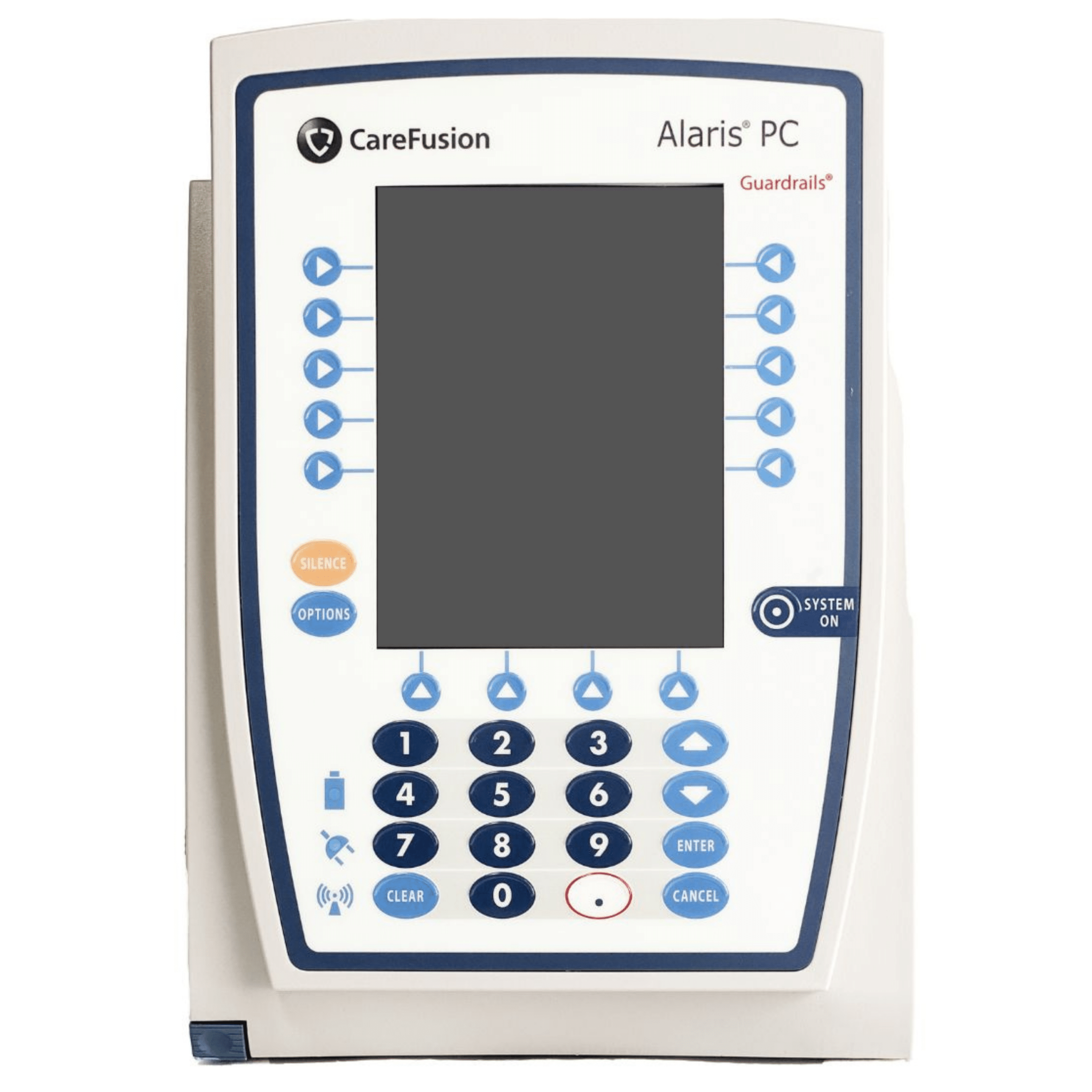
BD Alaris 8015 PC Unit (4.7″ Display)
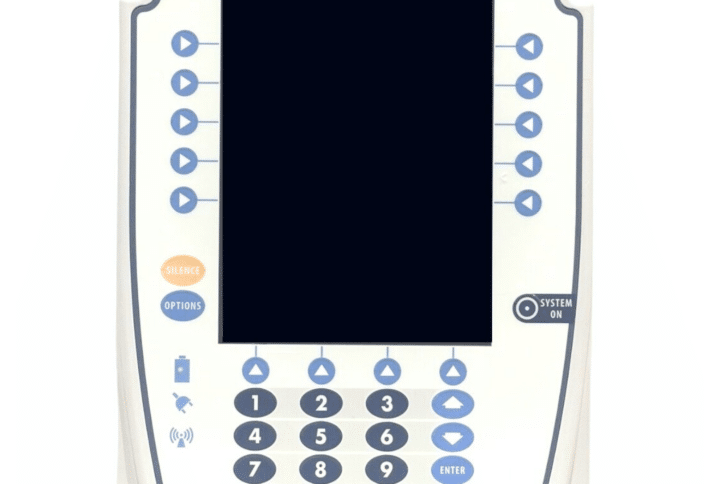
The BD Alaris 8015 PC Unit with the 4.7″ display is the original form factor of the Alaris PCU — the same modular command center that became one of the most deployed infusion platforms in North American acute care, just with a smaller screen. Everything that defines the Alaris system is here: up to four attached infusion and monitoring modules (pump, syringe, PCA, SpO2, EtCO2) under a single unified interface, Guardrails Suite MX running up to 30 care area profiles with facility-defined soft and hard dose limits, and wireless connectivity via Alaris Systems Manager for fleet-wide drug library updates and CQI reporting. The 4.7″ display is smaller than the 5.7″ variant but runs the same software, accepts the same modules, and fits the same pole clamp — meaning any facility already running 4.7″ units can add to the fleet without retraining staff or changing workflows.
If your facility needs the larger screen for high-acuity environments where bedside visibility matters, the 5.7″ version is also available from IPR Medical. Also available: BD Alaris 8015 with 5.7″ display But if you’re stocking up on a proven platform at a lower price point, or simply replacing units in an existing 4.7″ fleet, this is a cost-effective way to do it without compromising on capability.
IPR Medical buys, sells, repairs, and stocks parts for the BD Alaris 8015. Call us at 855-477-8866 or email cs@iprmed.com.
BD Alaris 8015 PC Unit (4.7″ Display) — Specifications
The 4.7″ display is the original screen form factor of the 8015 PCU. The PCU is the controller only — infusion and monitoring modules are sold separately. Also available: BD Alaris 8015 with 5.7″ display.
| Manufacturer | BD (Becton, Dickinson and Company) / CareFusion |
| Model | Alaris PC Unit, Model 8015 (4.7″ display — original screen form factor) |
| Software Compatibility | Guardrails Suite MX with Guardrails Point-of-Care software; compatible with v9.x through v12.x OS software |
| Intended Use | Central controller for the Alaris modular infusion system; intended for adult, pediatric, and neonatal patients in professional healthcare facilities |
| Infusion Routes | Intravenous (IV), intra-arterial (IA), subcutaneous, epidural, irrigation of fluid spaces (route determined by attached module) |
| Display | 4.7″ full-color LCD; uses color to communicate programming, infusion status, monitoring, and hospital-defined policy information |
| Compatible Modules | Up to 4 infusion/monitoring modules: Pump Module 8100, Syringe Module 8110, PCA Module 8120, SpO2 Modules 8210/8220, EtCO2 Module 8300; Auto-ID Module 8600 recognized as 5th module |
| Guardrails Drug Library | Up to 30 patient-specific care area profiles (Profiles); each profile contains a Drug Library, IV Fluid library, channel labels, and instrument configurations; soft and hard dose limits per drug entry |
| Data Set / Library Transfer | Via wireless network (Alaris Systems Manager); RS-232 serial port (RJ45 connector) |
| Wireless Battery Options | Standard (non-wireless), 802.11b, 802.11b/g, and 802.11a/b/g/n wireless battery modules available |
| Battery | 12V, 4000 mAh Nickel-Metal Hydride (NiMH); charges whenever connected to AC; typical battery life ~2 years under normal use and maintenance |
| Battery Runtime (typical, new battery) | 6 hrs (1 pump module at 25 ml/h); 3 hrs (4 pump modules at 25 ml/h); 6 hrs (1 syringe or PCA module at 5 ml/h); 3 hrs (4 syringe modules at 5 ml/h); 4.5 hrs (1 SpO2 module); 4 hrs (1 EtCO2 module) |
| AC Power | 100 – 240 VAC, 50/60 Hz, 150 VA max |
| Communication Data Port | RS-232 with RJ45 connector |
| Memory | Compact flash: application software, audio, Data Set, OS software; on-board flash: boot software, event/error/battery logs (nonvolatile); module parameters retained 8 hrs after power-off |
| Electric Classification | Class I, Internally Powered Equipment |
| Shock Protection | Type CF, Defibrillator-Proof (patient-applied part) |
| Fluid Ingress Protection | IPX1 (Drip Proof) |
| Mode of Operation | Continuous |
| Equipment Orientation | Must remain upright during operation |
| Dimensions | 8.8″ H × 6.9″ W × 9.0″ D (22.4 cm × 17.5 cm × 22.9 cm), including pole clamp |
| Weight | 7.2 lbs (3.27 kg) |
| Also Available | BD Alaris 8015 with 5.7″ display — larger screen variant, same modular platform |
| FDA Device Corrections | Multiple Class I recalls and corrections on record for the Alaris 8015 platform — see Documents tab and contact IPR Medical at 855-477-8866 for current software version and remediation guidance. |
IPR Medical buys, sells, repairs, and stocks parts for the BD Alaris 8015 PC Unit. Contact us at 855-477-8866 or cs@iprmed.com.
Trademark Notice: BD, and all other brand names, model names, and part numbers shown are trademarks of their respective owners and are used on this page only to identify the original manufacturer’s equipment offered here, consistent with nominative fair use. This listing is offered by IPR Medical, an ISO 9001:2015-certified independent service organization, and is not sponsored by, affiliated with, or endorsed by BD.
Overview
The BD Alaris 8015 PC Unit with the 4.7″ display is the original form factor of the Alaris PCU — the central controller for the Alaris modular infusion system. It doesn’t infuse on its own; it’s the command center that gives up to four simultaneously attached infusion and monitoring modules a unified color interface, a shared Guardrails drug library, and a single point of programming, monitoring, and alarm management. The 4.7″ screen is smaller than the 5.7″ variant introduced later, but it runs the same Guardrails Suite MX software, accepts the same Alaris modules, and fits the same pole clamp hardware. For facilities with an existing 4.7″ Alaris fleet, adding units of this variant means no retraining, no workflow changes, and no hardware compatibility issues. For facilities building a new Alaris deployment on a tighter budget, it delivers the full Alaris feature set at a lower acquisition cost than the larger screen model.
4.7″ vs. 5.7″ — Which Version Is Right for Your Facility?
The core functional difference between the 4.7″ and 5.7″ Alaris 8015 PCU is the display size. Both versions run the same Guardrails Suite MX software, support the same wireless battery modules and care area profile configurations, accept the same modules, and are subject to the same FDA recall and remediation history. The 5.7″ display offers a larger, easier-to-read screen — particularly useful in high-acuity settings where clinicians need quick visual confirmation of multiple running parameters from a slight distance. The 4.7″ version is the right choice when facilities are adding to an existing 4.7″ fleet, when screen size is not a clinical priority, or when budget is the primary consideration. Both versions are available from IPR Medical — the 5.7″ version is listed here.
Guardrails Suite MX and Drug Library
The Alaris 8015 runs Guardrails Suite MX — BD’s comprehensive medication error prevention software — which supports up to 30 patient-specific care area profiles. Each profile carries its own Drug Library, IV Fluid library, channel labels, and instrument configuration settings appropriate to the care area. Drug entries can carry Hard Limits that cannot be overridden during programming, and Soft Limits that can be overridden with clinical confirmation — giving pharmacy teams precise control over dosing boundaries across different patient populations. Optional Clinical Advisories provide on-screen guidance at the drug level. Data Sets are developed using the Guardrails Editor software by a facility’s own clinical team, transferred to the fleet via Alaris Systems Manager, and activated by clinical staff. CQI event data from every infusion alert is stored on-board and accessible via Guardrails CQI Reporter for ongoing safety analysis.
Modular Architecture and Compatible Modules
The Alaris 8015 PCU accepts up to four infusion or monitoring modules attached to either side of the unit or daisy-chained from one another. Modules are identified by position (A, B, C, D) from left to right. Adding or removing a module while the system is powered on does not interrupt active infusions on other channels — the system reidentifies module positions automatically. Compatible modules include the Alaris Pump Module 8100 (large-volume), Syringe Module 8110, PCA Module 8120, SpO2 Modules 8210 and 8220, and the EtCO2 Module 8300. The Auto-ID Module 8600 can be added as a recognized fifth module, combining Guardrails dose limit technology with barcode scanning for IV solution auto-selection and patient ID verification. Only one PCA module and one SpO2 module can be connected at a time.
Wireless Connectivity and Fleet Management
The Alaris 8015 supports four wireless configurations depending on the battery module installed: standard (non-wireless), 802.11b, 802.11b/g, and 802.11a/b/g/n. When connected to wireless infrastructure, the PCU integrates with Alaris Systems Manager, enabling bi-directional data exchange — pushing updated Data Sets to the fleet and pulling pump event and CQI logs for centralized review. If wireless communication is interrupted, the system operates normally in manual mode without loss of infusion function. Because the wireless standard is determined by the battery module rather than the PCU itself, upgrading wireless capability on an existing 4.7″ fleet requires only a battery module swap — the PCU does not need to be replaced.
Battery and Power
The Alaris 8015 PCU is powered by a 12V, 4000 mAh Nickel-Metal Hydride (NiMH) battery that charges whenever the unit is connected to AC power, regardless of whether the pump is on or off. Battery runtime varies with the number and type of modules attached. With a single pump module infusing at 25 ml/h, a new, fully charged battery delivers approximately 6 hours of runtime; four pump modules at 25 ml/h reduces that to approximately 3 hours. Syringe and PCA configurations at 5 ml/h run approximately 6 hours for a single module and 3 hours for four. SpO2 monitoring runs approximately 4.5 hours; EtCO2 approximately 4 hours. Expected battery life is approximately 2 years under normal use and maintenance conditions.
FDA Device Corrections and Safety Bulletins
The BD Alaris System — including the 8015 PC Unit in both 4.7″ and 5.7″ screen configurations — has been subject to multiple FDA recalls and device corrections since 2020. All 8015 PCUs regardless of screen size are subject to the same recall and remediation requirements. Facilities operating Alaris 8015 PCUs should verify current software versions and review active recall status with their biomedical engineering and pharmacy teams. IPR Medical recommends contacting BD directly to determine remediation status and scheduling for any affected units.
1. Class I Voluntary Recall (February 2020) — Software Anomalies: BD initiated a voluntary recall affecting approximately 774,000 Alaris System devices in the U.S. after identifying multiple software problems: inaccurate system error codes that could cause medication interruption or pump shutdown; interference with the delay start programming function; low battery alarm failures that could result in unannounced power loss mid-infusion; KVO alarm misprioritization; and customer concentration programming inaccuracies that could produce dosing errors. The FDA reported 55 injuries and 1 death associated with this recall at the time of classification. BD directed facilities to follow mitigation steps outlined in customer communications and announced plans for a software update to remediate the issues.
2. Additional Class I Recalls (June–August 2020) — Hardware and Software: BD issued additional voluntary recalls in mid-2020 covering hardware issues that could result in pump malfunction, along with further software-related corrections. Several of these were designated Class I by the FDA.
3. Remediation and 510(k) Clearance (2021–2023): BD filed a 510(k) submission in April 2021 covering software version 12.1.2 and various hardware updates. Remediation of affected fleet units began in July 2021. The FDA granted 510(k) clearance for the updated BD Alaris System in July 2023, covering updated PCU hardware, new software with cybersecurity enhancements, and interoperability improvements. BD committed to remediating or replacing all current U.S. market Alaris devices with the 510(k)-cleared version.
4. Cybersecurity Bulletins (2020–2023): BD voluntarily disclosed several cybersecurity vulnerabilities affecting the Alaris 8015 PCU across multiple bulletins. Notable disclosures include: a wireless credential exposure vulnerability on PCUs running software v9.5 or earlier (requires physical disassembly to exploit); a network session denial-of-service vulnerability (CVE-2020-25165) affecting wireless capability, patched in software v12.1.1 and later; and eight additional CVEs disclosed in 2023 affecting versions 12.1.3 and earlier. BD assessed clinical patient safety impact of all disclosed vulnerabilities as low probability, and no exploits in clinical environments have been reported for any of these vulnerabilities.
Action recommended: Facilities operating BD Alaris 8015 PCUs should verify the installed software version on each unit, confirm remediation status with BD, and ensure units have been updated to software v12.1.1 or later to address known cybersecurity vulnerabilities. IPR Medical can assist with parts and service — call 855-477-8866 or email cs@iprmed.com.
Because FDA device corrections and safety communications may be updated or expanded after the date of this listing, IPR Medical recommends that facilities also check the FDA’s official resources directly to ensure they have the most current information:
IPR Medical — Your Source for the BD Alaris 8015
IPR Medical buys, sells, repairs, and stocks parts for the BD Alaris 8015 PC Unit in both the 4.7″ and 5.7″ screen configurations. Whether you need a refurbished unit, a replacement component, or service support for an existing Alaris fleet, our team is equipped to help. The 5.7″ display version is also available here.
IPR Medical buys, sells, repairs, and stocks parts for the BD Alaris 8015 PC Unit. Contact us at 855-477-8866 or cs@iprmed.com.
Trademark Notice: BD, and all other brand names, model names, and part numbers shown are trademarks of their respective owners and are used on this page only to identify the original manufacturer’s equipment offered here, consistent with nominative fair use. This listing is offered by IPR Medical, an ISO 9001:2015-certified independent service organization, and is not sponsored by, affiliated with, or endorsed by BD.
| Weight | 7.5 lbs |
|---|---|
| Dimensions | 14 × 14 × 14 in |
| Product Condition |
You may also like…
BD Alaris 8015 PC Unit (5.7″ Display)
Original price was: $1,295.00.$895.00Current price is: $895.00.
Alaris 8100 Pump Module
Original price was: $895.00.$495.00Current price is: $495.00.

Alaris BD 8110 Syringe Pump Module
Original price was: $1,895.00.$1,495.00Current price is: $1,495.00.Related Products

ICU Medical/ Hospira Plum 360
Original price was: $1,995.00.$1,150.00Current price is: $1,150.00.
Baxter Sigma Spectrum Version 6
Original price was: $995.00.$795.00Current price is: $795.00.


Reviews
There are no reviews yet.