




BD Alaris 8100 Large Volume Pump Module – Recertified
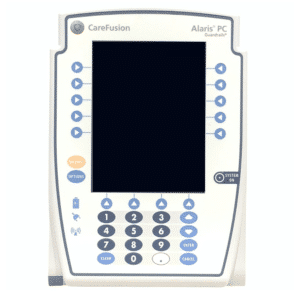
The BD Alaris™ 8100 Pump Module is the large-volume infusion channel of the widely deployed Alaris System — a modular, point-of-care infusion platform that has been a cornerstone of IV medication safety programs in hospitals across the United States for over two decades. Designed to attach to the Alaris PC Unit (PCU, Model 8015 — including the BD Alaris 8015 PC Unit (v12.3 Software)), the 8100 operates as one channel in a system that can accommodate up to four pump modules on a single PCU, enabling clinicians to manage multiple independent infusions from a unified interface. Each channel delivers fluids, medications, blood, and blood products to adult, pediatric, or neonatal patients across intravenous, intra-arterial, subcutaneous, epidural, and irrigation routes.
The 8100 delivers from 0.1 to 999 ml/h with ±5% accuracy (±5.5% at rates below 1 ml/h), supports secondary (piggyback) infusion mode, drug calculation, multi-dose programming (on PCU software earlier than v12), dynamic downstream pressure display, and configurable occlusion pressure thresholds. Its color-coded LED status indicators — red for alarm, yellow for pause, green for infusing — let nurses assess the state of every channel at a glance without approaching the bedside. At 2.5 lbs and measuring 3.3″ × 8.9″ × 5.5″, the module attaches to either side of the PCU in under a minute and can be hot-swapped while other channels continue infusing.
IPR Medical buys, sells, repairs, and stocks parts for the BD Alaris 8100 Pump Module. Whether you need to expand an existing Alaris fleet, replace failed modules, or establish a service contract for preventive maintenance, our team can help. Contact us at 855-477-8866 or cs@iprmed.com.
Rx only. Sold to healthcare facilities, licensed practitioners and equipment service providers; not sold to patients for home use (Terms §8).
Warranty: IPR Medical limited warranty, 6 months unless a longer period is stated on this page or your invoice; extended warranties available (Terms §5).
BD Alaris™ 8100 Pump Module — Specifications
| Manufacturer | BD (Becton, Dickinson and Company) / formerly CareFusion |
| Model | Alaris™ Pump Module, Model 8100 |
| System Platform | BD Alaris System (Medley / Guardrails Suite MX) — module requires Alaris PCU Model 8015 or 8000 to operate |
| Device Type | Large-Volume Infusion Pump Module — peristaltic; modular channel |
| Intended Use | Continuous or intermittent delivery of fluids, medications, blood, and blood products; adult, pediatric, and neonatal patients; IV, intra-arterial, subcutaneous, epidural, and irrigation routes (BD’s v12 labeling contraindicates the enteral route) |
| Modules per PCU | Up to 4 pump modules per single PCU (attachable to either side); hot-swappable while other channels continue infusing |
| Flow Rate Range | 0.1–99.9 ml/h in 0.1 ml/h increments; 100–999 ml/h in 1 ml/h increments |
| Rate Accuracy | ±5% at rates 1–999 ml/h; ±5.5% at rates below 1 ml/h (95% confidence, 95% of the time; measured at 68°F ±4°F, source container 20″ above pump, distilled water, 0 mmHg back pressure, 18 Ga needle, Admin Set Module 2210) |
| VTBI Range | 0.1–9,999 ml in 0.1 ml increments |
| KVO Rate | Adjustable; activates after infusion complete to keep vascular access patent |
| Drug Safety Software | Guardrails® Suite MX — facility-defined drug library with hard and soft limits; tests reasonableness of every entry before therapy starts; supports care area (profile) selection per patient population (ICU, Med-Surg, NICU, OR, Oncology, etc.) |
| Compatible Software Versions | v9.17 (backward compatible with older versions); v9.33 (compatible with v9.33 only); v12.x (BD-branded modules; v12 removes Multi-dose and the Delay Until option and adds 125 and 175 mcL air-in-line thresholds) |
| Drug Library / Profiles | Configurable care area profiles (Drug Library, IV Fluid Library, Channel Label Library); drug calculation allows entry of dose in clinical units with pump computing rate; concentration limits; bolus dose programming |
| Infusion Modes | Continuous; Secondary (piggyback — primary/secondary switching with auto-return to primary); Bolus dose; Multi-dose (PCU software earlier than v12; removed in v12.x); Delay options |
| Occlusion Detection | Upstream and downstream occlusion detection; Downstream Occlusion Detection (DOD) minimizes nuisance alarms from momentary tubing kinking; adjustable occlusion pressure threshold (selectable high/low); auto-restart attempts after patient-side occlusion (configurable) |
| Dynamic Pressure Display | Yes — real-time downstream line pressure displayed on module during infusion |
| Air-in-Line Detection | Yes — configurable air accumulation threshold; tubing guide arm secures set in air-in-line detector; small-bubble (accumulated air) detection mode also available |
| Free-Flow Protection | Set-based anti-free-flow protection; automatic clamp upon door opening; SmartSite® needle-free valves compatible |
| Status Indicators (LED) | Three-color LED: Red = alarm; Yellow = pause; Green = infusing |
| Display | Built-in backlit LCD on module displays drug/IV fluid name, dose, and rate; programming and main interface on PCU display |
| Tamper Resist | One-touch front panel keypad lockout during active infusion; Tamper Resist switch on PCU rear |
| Patient ID / Channel Label | Optional alphanumeric 16-character Patient ID; configurable channel labels |
| Connectivity / Interoperability | Wired and wireless network connectivity via PCU; compatible with EMR/BCMA interoperability systems; Guardrails® CQI Reporter for clinical quality improvement data; data set (drug library) stored in compact flash memory on PCU |
| Administration Sets | Proprietary BD/Alaris infusion sets with anti-free-flow protection; multiple configurations including filtered, non-filtered, piggyback, and specialty sets. IPR Medical stocks Alaris-compatible administration sets for the 8100 Pump Module. |
| Weight | 2.5 lbs |
| Dimensions (W × H × D) | 3.3″ × 8.9″ × 5.5″ (8.4 cm × 22.6 cm × 14.0 cm) |
| Operating Temperature | 41–104°F (5–40°C) |
| Battery (System) | NiMH battery in PCU; runtime approximately 1 hour with 4 pump modules infusing at 999 ml/h + Auto-ID module (new, fully charged); runtime extends significantly at lower flow rates |
| Memory | System configuration and data set stored on PCU compact flash; events and error logs in onboard PCU flash (nonvolatile; retained through power loss) |
| Maintenance | Annual preventive maintenance recommended; scheduled maintenance reminder displayed on startup; between-patient check-in procedure via System Maintenance software |
| BD Alaris vs. Alaris Hardware | BD lists BD Alaris-specific door cover, membrane frame assembly, logic board, door latch kit, door/keypad kit, bezel assembly kit (49000437), and rear case as not interchangeable with older Alaris 8100 parts; confirm hardware generation before ordering parts |
| FDA Device Corrections / Recalls | Open Class I actions include the 2025–2026 recall of BD Alaris Pump Infusion Sets (Guardrails Suite MX software up to v12.6), the October 2025 dropped/jarred bezel correction, BD’s July 2025 legacy bezel kit update, and the 2020 keypad fluid-ingress recall. Class 2 corrections cover IUI connectors (2024), a v12.1.2 firmware timestamp issue (2025), and a user-manual safety clamp instruction (2025). See the Description tab for details and recommended actions. |
IPR Medical buys, sells, repairs, and stocks parts and administration sets for the BD Alaris™ 8100 Pump Module. Contact us at 855-477-8866 or cs@iprmed.com.
Trademark Notice: BD, and all other brand names, model names, and part numbers shown are trademarks of their respective owners and are used on this page only to identify the original manufacturer’s equipment offered here, consistent with nominative fair use. This listing is offered by IPR Medical, an ISO 9001:2015-certified independent service organization, and is not sponsored by, affiliated with, or endorsed by BD.
Quick answer: The BD Alaris 8100 Pump Module is the large-volume infusion channel of the Alaris System. It attaches to the Alaris PC Unit and delivers 0.1 to 999 ml/h with ±5% accuracy for adult, pediatric, and neonatal patients. IPR Medical sells recertified modules backed by IPR Medical’s warranty, repairs them, and stocks Alaris-compatible administration sets.
Overview
The BD Alaris™ 8100 Pump Module is the large-volume infusion channel at the heart of the Alaris System — one of the most widely deployed modular smart pump platforms in American hospitals. Originally developed and marketed by Alaris Medical Systems, then by Cardinal Health, then by CareFusion, and acquired by BD (Becton, Dickinson and Company) in March 2015, the Alaris 8100 has remained the standard large-volume pump module for facilities running the Alaris Medley platform for more than two decades. It works in tandem with the Alaris PC Unit (PCU, Model 8015 or 8000), which provides the primary display, drug library, networking, and battery — while the 8100 module provides the pumping mechanism, channel-level LED status display, downstream pressure monitoring, and set-based safety features for each independent infusion channel.
The Alaris Modular System Architecture
The defining design principle of the Alaris System is modularity. Up to four 8100 Pump Modules can be attached to a single PCU — on either side, in any combination with other Alaris modules (syringe pump module 8110, PCA module, EtCO2 monitoring module, SpO2 module on PCU software earlier than v12.1.2, or Auto-ID module) — creating a bedside infusion and monitoring system tailored precisely to each patient’s needs. All channels share a single user interface on the PCU’s color display, a single wireless network connection, and a single battery for transport. When a new module is needed, it can be hot-attached while other channels continue infusing without interruption. This architecture reduces the number of individual standalone pumps cluttering an ICU or stepdown room, simplifies programming by centralizing the interface, and reduces training burden because clinicians learn one system rather than multiple independent pumps.
The 8100 connects to the PCU via the Alaris IUI (Instrument Unit Interface) connector system — a mechanical and electronic interface that allows power, data, and alarm communication between the PCU and each attached module. The module’s own backlit LCD displays the essential channel information (drug name, dose, rate) directly on the module face, so nurses can confirm infusion status without looking at the PCU screen. The three-color LED array — green for actively infusing, yellow for pause or hold, red for alarm — provides room-level visual status that is readable even from the doorway.
Guardrails® Suite MX Drug Safety Software
The Alaris 8100 supports Guardrails® Suite MX, BD’s dose error reduction software that has become the industry standard for smart pump safety in US hospitals. Guardrails works by loading a facility-defined drug library onto the PCU — organized into care-area profiles (ICU, Med-Surg, NICU, Labor and Delivery, OR, Oncology, etc.) — and checking every manually entered programming value against the library’s defined hard and soft limits before allowing the infusion to start. When a clinician programs a rate or dose that falls outside a soft limit, the system prompts for confirmation. When a value exceeds a hard limit, the system refuses to accept the entry. This “test of reasonableness” catches transcription errors, decimal-point errors, and unit-of-measure mismatches — three of the most common and dangerous categories of IV medication error — before any drug reaches the patient.
For facilities that have invested in Guardrails CQI Reporter, the system’s event and alert logs can be analyzed over time to identify patterns — which drugs most frequently trigger limit alerts, how often clinicians override soft limits, and which care areas or shifts have the highest alert rates. This continuous quality improvement capability turns the pump’s safety alert data into actionable intelligence for pharmacy and patient safety programs.
Flow Accuracy, Delivery Modes, and Clinical Features
The 8100 delivers across a flow rate range of 0.1 to 999 ml/h, with the precision increment of 0.1 ml/h at low rates (below 100 ml/h) stepping up to 1 ml/h increments above 100 ml/h. Rate accuracy is ±5% at rates between 1 and 999 ml/h, and ±5.5% below 1 ml/h, measured under standardized conditions per IEC 60601-2-24. VTBI (volume to be infused) is programmable from 0.1 to 9,999 ml in 0.1 ml steps. The KVO (keep vein open) rate activates automatically upon infusion completion, maintaining vascular access patency at a minimal configurable rate until the next infusion is programmed.
Beyond simple continuous infusion, the 8100 supports secondary (piggyback) mode — programming a primary maintenance infusion alongside a secondary antibiotic or medication piggyback, with the pump automatically switching to the secondary when the primary is paused and returning to the primary when the secondary bag empties. Bolus dose, multi-dose (on PCU software earlier than v12), and delay options give clinicians additional flexibility for scheduled intermittent therapies. The drug calculation feature allows nurses to enter the desired clinical dose (in mg/h, mcg/kg/min, mEq/h, or other units) and have the pump compute the delivery rate automatically from the programmed drug concentration — eliminating one of the most error-prone mental arithmetic steps in IV programming.
Occlusion Detection, Safety, and Downstream Pressure Display
The 8100 implements both upstream and downstream occlusion detection. The Downstream Occlusion Detection (DOD) system is specifically designed to reduce nuisance alarms from transient causes — a patient’s arm position momentarily kinking the distal tubing, for example — by distinguishing between a brief pressure spike and a sustained occlusion before triggering an alarm. Downstream occlusion pressure threshold is user-configurable (selectable high/low settings), allowing facilities to calibrate the alarm sensitivity to their patient population and catheter types. Auto-restart attempts following a patient-side occlusion are also configurable, automatically retrying before escalating to a full alarm.
A real-time dynamic downstream line pressure display on the module face gives nurses continuous visibility into patient-side back pressure — a feature that helps identify developing occlusions before they trigger an alarm, and assists in managing patients where pressure trends are clinically significant, such as arterial line infusions. Air-in-line detection is active throughout the infusion, with a configurable accumulation threshold that determines how much air is tolerated before alarming. A small-bubble accumulated air mode handles situations where microbubbles individually below the alarm threshold accumulate over time.
Administration Sets and Consumables
The Alaris 8100 requires proprietary BD/Alaris infusion sets that incorporate set-based anti-free-flow protection — a mechanism that automatically occludes the tubing when the pump door is opened, preventing gravity-driven free flow during set changes. Administration set configurations available for the 8100 include standard non-filtered sets, filtered sets, secondary/piggyback-capable sets, macro and micro drip options, and specialty sets for epidural, arterial, and other routes. A tubing guide arm on the module secures the set within the air-in-line detector, preventing accidental dislodgement during patient movement.
IPR Medical stocks Alaris-compatible administration sets for the 8100 Pump Module, giving facilities a reliable source for their consumables alongside their pump service needs.
FDA Device Corrections and Safety Bulletins
The BD Alaris 8100 has an extensive FDA correction history, and several actions remain open as of October 2026. Before placing any module in service, facilities should check its serial number, service history, and the infusion sets in use against BD’s current notices.
1. Class I Recall (2025–2026) — BD Alaris Pump Infusion Sets (Z-2179-2025 and related records): BD found that the 8100, when used with some compatible infusion sets, can fall outside stated ranges for flow rate and bolus accuracy, occlusion time to alarm, and post-occlusion bolus volume. Sets with restrictive components, such as filters, check valves, Y-sites, and microbore tubing, are most affected, especially at low rates and small bolus volumes. As of its October 2026 update, the FDA lists Guardrails Suite MX software up to v12.6. On August 19, 2026, BD directed customers to discard the sets on its discontinued list, to prioritize alternate sets for critical-care, neonatal, infant, and pediatric areas, and to consider the Alaris Syringe Module or another syringe pump when a set’s performance is not clinically appropriate. BD’s mitigations include keeping the container no more than 21 inches above the top of the pump module and not below it, seating the tubing over the pressure sensors with all clamps open, avoiding Selectable pressure mode above 50 mmHg at rates under 10 ml/h, and turning off flow to the patient before clearing an occlusion.
2. Class I Correction (October 2025, Z-0430-2026) — Dropped or Jarred Pump Modules: BD warned that a dropped or severely jarred pump module can have bezel assembly damage even when no damage is visible, which can cause under-infusion, over-infusion, unregulated flow, or calibration failure. The action covers BD Alaris Pump Modules distributed after June 19, 2004, and bezel kits 49000437 (8100BD) and 49000270. BD instructs facilities to remove any dropped or jarred module from use and send it to biomedical engineering for testing under BD’s Level of Testing Guidelines, including rate accuracy verification, and to inspect modules before every use.
3. Legacy Bezel Kit Update (July 2025): BD reiterated its Class I recall of bezel kit assemblies made April 2011 through June 2017 from FR-110 resin, which can weaken over time and lead to bezel post separation, free flow, over- or under-infusion, or interrupted infusion. BD issued the update after finding that recalled kits were still being used to service pumps, so it applies to all Alaris and BD Alaris Pump Modules that may have been serviced with an affected kit. BD instructs facilities to dispose of any affected kits on hand, review service records, visually inspect the bezel on modules serviced with affected kits, and remove any affected pump from service and contact BD. The original recall (Z-1768-2019) was terminated by the FDA in December 2023.
4. Class 2 Correction (November 2025, Z-1217-2026) — Firmware Timestamp: A limited group of BD Alaris Pump Modules on software v12.1.2 (listed by serial number) was flashed with a date and time that falls in a daylight saving time transition. BD Alaris Systems Manager rejects that timestamp, and the PCU can lose its network connection in bi-directional EMR interoperability workflows. BD instructs facilities to return affected modules to biomedical engineering for re-flashing.
5. Class 2 Labeling Correction (January 2025, Z-1231-2025) — Safety Clamp Instruction: BD Alaris System user manuals v12.3.1, v12.3.2, and v12.4 incorrectly said to leave the safety clamp open when reloading a set. BD instructs facilities to post its customer notice near affected systems until corrected manuals are issued.
6. Class 2 Correction (August 2024, Z-3142-2024) — IUI Connectors: BD identified an increase in bent contacts on the new female (left) IUI connectors, which can make a module inoperable and delay the start of an infusion. The FDA record lists specific serial numbers. BD instructs users to inspect all IUI connectors before use and to send any module with a bent or lifted pin to biomedical engineering or qualified service personnel.
7. Class I Recall (August 2020, Z-2939-2020) — Keypad Fluid Ingress (open): Keys on the 8100 can become stuck or unresponsive after fluid ingress, delaying or interrupting infusion. The recall covers the 8100 and door assembly replacement kits 49000239, 49000346, 49000438, and 49000439. BD instructs facilities to follow its cleaning instructions (no dripping cloths and no direct spraying) and to discard uninstalled door kits dated before January 25, 2019.
Action recommended: Before placing any 8100 in service, confirm it has not been dropped or jarred, review its service history for legacy FR-110 bezel kits, inspect the bezel and both IUI connectors, and check the infusion sets in use against BD’s current discontinued list. IPR Medical can assist with inspection, repair, and preventive maintenance — contact us at 855-477-8866 or cs@iprmed.com.
Because FDA device corrections and safety communications may be updated or expanded after the date of this listing, IPR Medical recommends that facilities also check the FDA’s official resources directly to ensure they have the most current information:
- FDA Medical Device Recalls Database
- FDA Medical Device Safety
- FDA MedWatch
- FDA — BD Alaris Pump Infusion Set Recall
- FDA — BD Alaris Pump Dropped/Jarred Correction
IPR Medical — Your Source for the BD Alaris 8100 Pump Module
IPR Medical buys, sells, repairs, and stocks parts and administration sets for the BD Alaris™ 8100 Pump Module. Our services for the Alaris 8100 include complete preventive maintenance, bezel assembly inspection and replacement, module-level repair, calibration, and refurbishment to OEM specifications. Whether you are expanding an existing Alaris fleet, replacing modules that have failed or been recalled, sourcing compatible administration sets, or need guidance on recall compliance inspection, IPR Medical has the expertise and inventory to help.
IPR Medical buys, sells, repairs, and stocks parts and administration sets for the BD Alaris™ 8100 Pump Module. Contact us at 855-477-8866 or cs@iprmed.com.
Frequently asked questions
How many 8100 modules can attach to one PC Unit?
Up to four 8100 Pump Modules can attach to a single Alaris PC Unit (Model 8015 or 8000), on either side and in any combination with other Alaris modules. A module can be attached while other channels keep infusing, and all channels share one display, one wireless connection, and one battery.
Does IPR Medical inspect the 8100 bezel for the recall?
Yes. BD’s original Class I bezel recall covered bezels made April 2011 to June 2017 and was terminated by the FDA in December 2023. In July 2025, BD extended its notice to all Alaris and BD Alaris Pump Modules that may have been serviced with legacy bezel kits, and in October 2025 it added inspection and testing requirements for dropped or jarred modules. IPR Medical provides bezel inspection and bezel assembly replacement, along with preventive maintenance, module-level repair, and calibration. Confirm bezel status before placing pre-June-2017 modules in service.
How do I send Alaris 8100 modules to IPR Medical for repair?
Submit an RMA request on iprmed.com to receive a free inbound FedEx or UPS shipping label (U.S. customers). We evaluate the modules within 1 to 2 business days and send a written estimate, with no charge until you approve. Repaired modules are tested to OEM specifications, cleaned, and covered by a 90-day warranty.
Repair service: IPR Medical also repairs BD Alaris pumps in house, with a free shipping label, a free evaluation and a 90-day repair warranty. See BD Alaris pump repair.
Trademark Notice: BD, and all other brand names, model names, and part numbers shown are trademarks of their respective owners and are used on this page only to identify the original manufacturer’s equipment offered here, consistent with nominative fair use. This listing is offered by IPR Medical, an ISO 9001:2015-certified independent service organization, and is not sponsored by, affiliated with, or endorsed by BD.
Buying a recertified BD Alaris 8100 Pump Module from IPR Medical
Every BD Alaris 8100 Pump Module sold by IPR Medical is a recertified unit that is inspected and tested by our team before it ships. Orders have a handling time of 1–2 business days, with $25 flat-rate shipping within the US (Alaska and Hawaii $80). Returns are accepted within 30 days, returned by mail, subject to a 25% restocking fee; see our returns policy for details.
Not sure this is the right model or version for your facility? Contact IPR Medical before you order and we will confirm compatibility and availability. You may also want to look at: all infusion pumps.
Alaris 8100 Guides from IPR Medical
- Alaris 8100 Repair: The Most Common Problems – what our technicians find most often, what causes it, and how to prevent it.
- Alaris 8100 Manuals and Documentation – directions for use, PC unit manuals and key specifications.
| Weight | 2.5 lbs |
|---|---|
| Dimensions | 5.5 × 3.3 × 8.9 in |
| Condition | Recertified (Refurbished) |
You may also like…


Related Products




Reviews
There are no reviews yet.