

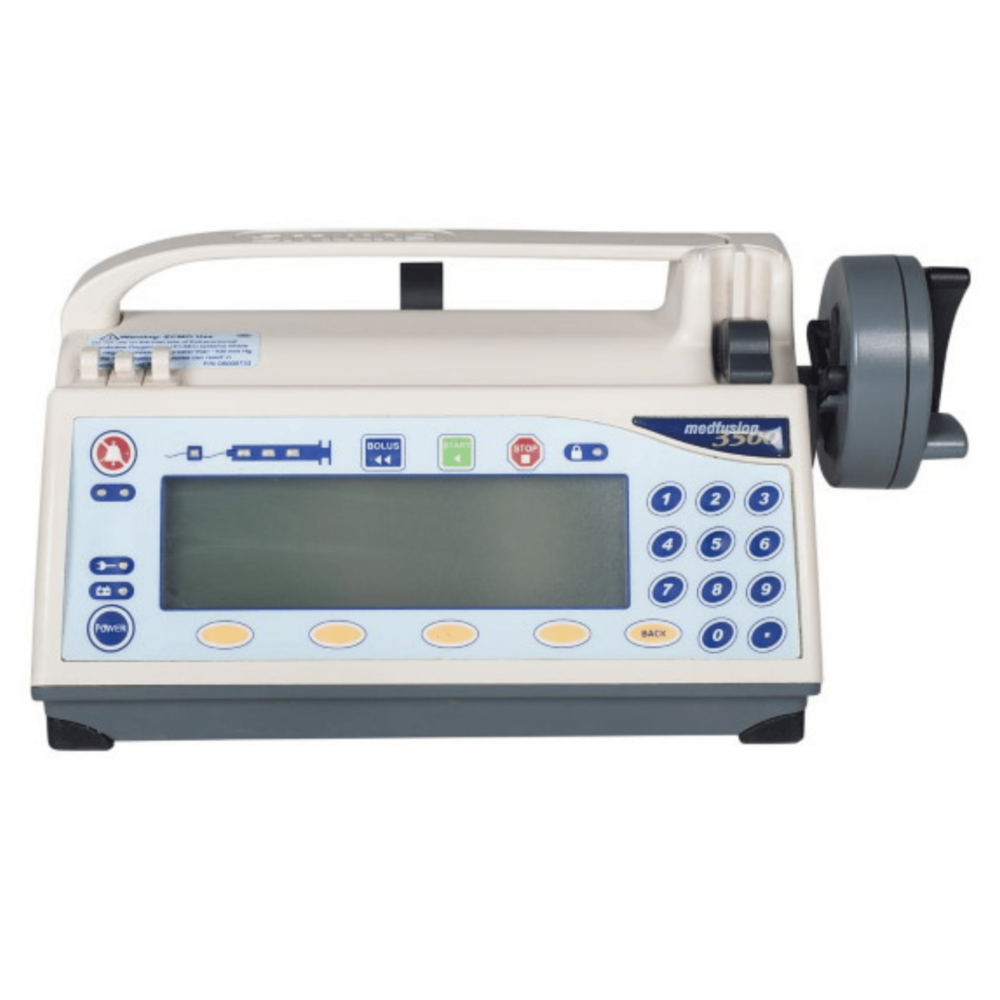
Quick answer: The Medfusion 3500 and Medfusion 4000 are both Smiths Medical syringe pumps that take 1 to 60 mL syringes, deliver 0.01 to 1130 mL/hr, and run PharmGuard dose error reduction with FlowSentry occlusion detection. The difference is connectivity and power: the 3500 is a stand-alone pump whose drug library is loaded with a converter box, while the 4000 talks to PharmGuard Server over wireless or wired Ethernet and runs on a longer-lasting lithium-ion battery. Choose the 3500 for a cost-effective stand-alone fleet; choose the 4000 if you want wireless drug-library updates and fleet data.
Both pumps share the same drive platform and much of the same clinical workflow, so the decision usually comes down to your network infrastructure, how you manage drug libraries, and budget. This guide compares them side by side.
Medfusion 3500 vs 4000 at a glance
| Feature | Medfusion 3500 | Medfusion 4000 |
|---|---|---|
| Syringe sizes | 1 to 60 mL | 1 to 60 mL, automatic size detection |
| Rate range | 0.01 to 1130 mL/hr | 0.01 to 1130 mL/hr |
| Dose error reduction | PharmGuard drug library (up to 8 categories of 36 drug programs per profile, 288 entries) with hard and soft limits | PharmGuard drug library (up to 8 categories of 36 drug programs per profile, 288 entries) with hard and soft limits |
| Occlusion detection | FlowSentry pressure monitoring | FlowSentry pressure monitoring with on-screen pressure trending |
| Drug library updates | Built in PharmGuard Toolbox 2, transferred by infrared or RS-232 converter box; cloning block copies a configuration pump to pump | Two-way communication with PharmGuard Server over wireless (IEEE 802.11, 2.4 GHz) or wired Ethernet |
| Battery | Rechargeable NiMH; at least 6 hours at 5 mL/hr with a 60 mL syringe | Rechargeable lithium-ion; about 10 hours at 5 mL/hr with a 60 mL syringe |
| Software versions at IPR Medical | Version 3, Version 5 and Version 6 | Confirm the firmware on the start-up screen before deployment |
| Recertified price at IPR Medical (October 2026) | $795 for any version while overstock lasts | $1,495 |
| Warranty from IPR Medical | 1 year; extended warranties available | 1 year; extended warranties available |
What the two pumps have in common
The Medfusion 4000 was built on the same trusted drive platform as the Medfusion 3500, so clinicians who know one pump can learn the other quickly. Both handle the precise, low-volume delivery that neonatal and pediatric intensive care, adult critical care, anesthesia and the operating room depend on. Both accept syringes from 1 to 60 mL, both cover 0.01 to 1130 mL/hr, and both support an unusually broad set of continuous and intermittent delivery modes, including dose per kg and dose per m² options.
Both also use PharmGuard Medication Safety Software. A pharmacy builds the drug library in PharmGuard Toolbox 2 and organizes it by profile, with hard limits that cannot be overridden and soft limits that warn but allow a confirmed override. FlowSentry monitors line pressure on both pumps for rapid occlusion detection.
Key differences
Connectivity and drug-library management
This is the biggest difference. The Medfusion 3500 is a stand-alone pump. Its drug libraries and configurations are built off-pump and transferred through an infrared or RS-232 connection using the OEM converter box, and a cloning block lets you copy a validated configuration from one pump to the next. That works well for facilities that want pharmacy-governed drug libraries without the infrastructure of a fully connected infusion system.
The Medfusion 4000 communicates in both directions with PharmGuard Server over wireless (IEEE 802.11, 2.4 GHz) or wired Ethernet. Pharmacy or biomed teams can push an updated drug library to the whole fleet without handling each pump, and pull event and alarm data back for continuous quality improvement.
Battery and portability
The 3500 runs on a rechargeable nickel-metal-hydride battery rated for at least six hours at 5 mL/hr with a 60 mL syringe. The 4000 uses a lithium-ion battery rated for about 10 hours under the same conditions, which helps during transport and long cases. The Medfusion 4000 weighs about 4.54 lb. Battery health matters on any secondary-market pump, so ask about battery condition before you buy.
Software versions and FDA corrections
Every Medfusion 3500 looks almost the same from the outside; the software version on the start-up screen determines its features and which FDA corrections apply. IPR Medical stocks recertified 3500 pumps in Version 3, Version 5 and Version 6. The Medfusion 4000 has also shipped with several firmware versions, so always confirm the installed version against the matching Operator’s Manual before placing a pump in service. For the 3500’s recall history in plain English, read our Medfusion 3500 recall and software versions guide.
Which pump should you choose?
Choose the Medfusion 3500 if:
- You run a stand-alone fleet and manage drug libraries with PharmGuard Toolbox 2 and a converter box.
- You want to match pumps you already own, including Version 3 or Version 5 fleets.
- Budget matters: recertified 3500 pumps are $795 for any version while our overstock lasts.
- You don’t have, or don’t need, PharmGuard Server and wireless infrastructure.
Choose the Medfusion 4000 if:
- You use PharmGuard Server, or plan to, and want wireless drug-library updates across the fleet.
- You want event and alarm data flowing back for quality-improvement reporting.
- Longer battery runtime matters for transport or long procedures.
Buying recertified from IPR Medical
IPR Medical is an ISO 9001:2015-certified independent service organization in Tustin, California. Every recertified pump is evaluated, repaired as needed and performance-tested in-house, and ships with a power cord and a 1-year IPR Medical warranty. Extended warranties are available.
- Shop the recertified Medfusion 3500 syringe pump (Version 3, 5 or 6)
- Shop the recertified Medfusion 4000 wireless syringe pump
- Medfusion repair service for pumps you already own
- Medfusion 3500 common problems and repair guide
- Medfusion 3500 manuals and documentation
Frequently asked questions
Is the Medfusion 4000 better than the Medfusion 3500?
Not for every facility. The 4000 adds wireless and wired PharmGuard Server connectivity and a longer-lasting lithium-ion battery. If you don’t use PharmGuard Server, a recertified Medfusion 3500 delivers the same syringe range, rate range and PharmGuard dose error reduction at a lower price.
Do the Medfusion 3500 and 4000 use the same syringes?
Both accept 1 to 60 mL syringes from the major syringe manufacturers listed in each pump’s Operator’s Manual. The 4000 detects syringe size automatically. Confirm the approved brands and sizes for your pump’s software version in its manual.
Can the Medfusion 3500 connect wirelessly?
No. The 3500 is a stand-alone pump. Drug libraries and configurations are transferred by infrared or RS-232 through the OEM converter box, and a cloning block copies a configuration between pumps. Wireless connectivity is a Medfusion 4000 feature.
How much does a recertified Medfusion 3500 or 4000 cost?
As of October 2026, IPR Medical sells recertified Medfusion 3500 pumps for $795 in Version 3, 5 or 6 while overstock lasts, and the recertified Medfusion 4000 for $1,495. Both include a 1-year warranty. Call (855) 477-8866 for multi-unit orders.
Does IPR Medical repair Medfusion pumps?
Yes. IPR Medical repairs, maintains and calibrates Medfusion 3500 and 4000 pumps in-house. Request a free shipping label to send pumps in.
Talk to IPR Medical
Not sure which pump fits your fleet? Call (855) 477-8866, Monday through Friday, 7:00 AM to 4:30 PM Pacific, or email cs@iprmed.com anytime.
Smiths Medical, Medfusion, PharmGuard and FlowSentry are trademarks of their respective owners and are used only to identify the original manufacturer’s equipment. IPR Medical is an ISO 9001:2015-certified independent service organization and is not sponsored by, affiliated with, or endorsed by Smiths Medical or ICU Medical.