



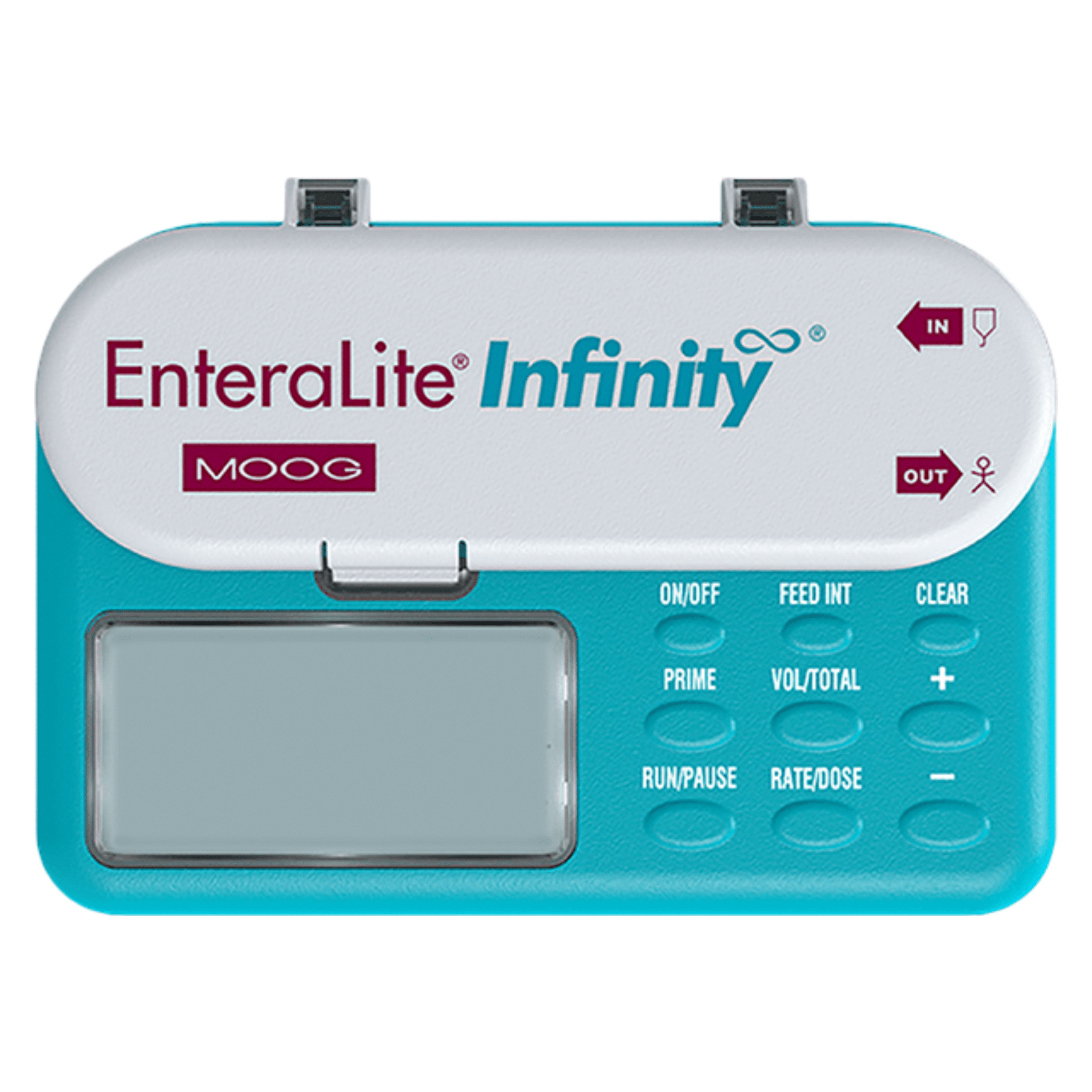
The most common Enteralite Infinity problems are broken, cracked or missing pump doors and door hinges, cracked cases, batteries that are fully drained or no longer hold a charge, failed main boards, worn or failed motors, and pumps that are due for a facility performance check. More than half of the Infinity pumps we evaluate arrive with a damaged or missing door or door hinge, and about two in five have two or more hardware problems at once, not counting a battery that only needed a charge. Most of this damage comes from drops and daily handling, so careful use, clean sensors and good charging habits prevent a large share of it.
The Enteralite Infinity is a small rotary peristaltic enteral feeding pump used in hospitals and home care, and designed to be carried in a Moog carry pack. Every Infinity sent to our Tustin, California lab gets a full diagnostic evaluation and an estimate before any work begins, and our technicians’ findings keep pointing to the same handful of problems.
Below are the findings that come up most, what usually causes each one, and what your team can do to avoid it. Display messages use the wording from Moog’s Infinity Operator’s Manual. (Moog acquired the pump’s original maker, ZEVEX, in 2007 and now markets it as the Infinity Enteral Feeding Pump, alongside the small-volume Infinity Orange.)
Source: IPR Medical service records for Enteralite Infinity (Blue) pumps that received a full diagnostic evaluation. Most pumps have more than one finding, so percentages add to more than 100. The two-or-more figure is estimated from a sample of recent evaluations. The Infinity Orange is the same size and weight and uses the same type of battery, but these figures come from Blue units.
1. Broken, Cracked or Missing Doors and Door Hinges
Found in 54% of pumps we evaluateThe pump door is the single most common problem we see on the Infinity. Doors arrive cracked, with a broken latch or clip, or missing altogether (about one in eight pumps comes in with no door at all). Often the hinges on the front case that hold the door are broken too, so a new door alone will not stay on. The manual is clear about why this matters: proper operation requires the door to be closed and latched whenever the motor is running. A door that will not latch shows up as SHUT DOOR alarms, and a cracked door or broken tab can also cause LOAD SET alarms because the cassette is not held in place.
Why it happens
The Infinity is built to be carried and is handled many times a day. The manual rates it to survive a drop from 3 feet, but repeated drops, pumps knocked off poles, and doors forced shut on a misaligned cassette wear out the door and its hinge points. Doors left open in a bag are easy to snap off.
How to avoid it
- Seat the cassette fully before closing the door, and never force the door shut over a misloaded set.
- Keep the door closed whenever the pump is not being loaded, including in storage and in carry packs.
- If the door will not stay closed, check the door latch and the latch pocket on the pump for cracks, as the manual directs, and send the pump in rather than taping the door shut.
2. Yearly Performance Check Due
Due for a facility performance check in 45% of pumps we evaluateMoog’s Operator’s Manual states that no routine calibration or adjustment is required for the Infinity, and its brochure states that no annual maintenance or calibration is required. Many hospitals, home infusion providers and DME fleets still schedule a yearly performance check under their own equipment management programs, and our technicians note that nearly half of the Infinity pumps we evaluate are due for one under their owner’s schedule. At IPR Medical, every pump we service is tested to the manufacturer’s specifications before it ships.
Why it happens
Infinity pumps move between patients, homes and facilities, so they are easy to lose track of. A pump that powers on and runs normally can still have a sensor or delivery accuracy problem that only a performance test will show.
How to avoid it
- Follow your facility’s equipment management program; if it calls for a yearly performance check, put every Infinity on the same schedule.
- Test any pump that has been dropped, has fluid damage or returns with an unexplained alarm before it is reissued.
3. Cracked and Damaged Cases
Found in 42% of pumps we evaluateCracked top and front cases are the next most common physical finding, followed by cracked rear and bottom cases. Counting doors, hinges and cases together, about seven in ten Infinity pumps we evaluate have some physical damage.
Why it happens
The same drops that break doors crack housings. A cracked case matters more than it looks: the manual rates the Infinity IP25 and allows it to be rinsed under a stream of warm water, but that protection depends on an intact case and door. Once the case is cracked, cleaning water and spilled formula can reach the electronics.
How to avoid it
- Tighten the pole clamp fully and confirm the pump is seated before letting go.
- Take any pump with a cracked case out of service and stop rinsing it under water until the case is repaired.
4. Drained or Failing Batteries and Charging Problems
Found in 32% of pumps we evaluateThe manual rates the Infinity’s lithium-ion battery for 24 hours at 125 ml/hr (9 hours at 600 ml/hr), with about 6 hours to recharge. Most pumps sent in as “not turning on” simply had a fully depleted battery. About one in ten pumps we evaluate needs a new battery because it will not hold a charge, has reached the end of its life or is missing. On the pump, a low battery shows as LOW BATT, a battery that is not charging shows as a flashing battery symbol with a flashing E and F on the fuel gauge, and in our lab an ER99 alarm has most often traced to a depleted or failing battery, though some of those pumps also had a main board or motor fault.
Why it happens
The manual puts expected battery service life at 2 to 5 years; high flow rates, frequent charging and extreme temperatures shorten it, and batteries lose charge in long storage or hot cars. Charging for less than 10 minutes after a low-battery shutdown can cause an ER99 alarm, and damaged charger pins or ports stop charging altogether.
How to avoid it
- Charge new or stored pumps for 6 hours before running on battery, as the manual recommends.
- After a low-battery shutdown, recharge fully rather than for a few minutes.
- Charge between 10 °C and 40 °C (the manual’s charge temperature range) and do not store pumps in hot vehicles.
- If the battery symbol and the E and F flash while the pump is plugged in, or the plug symbol never appears with a known-good outlet and charger, send the pump in.
5. Main Board Failures and Fluid Damage
Found in 22% of pumps we evaluateDefective main boards are the most common electronic finding, and about one in twenty pumps shows corrosion or fluid intrusion on the board. Symptoms include a pump that will not power on with a good battery, unresponsive buttons, a flickering display or a self-test error. The manual groups self-test failures as ER01 – ER99 and does not publish meanings for individual codes; in the small number of pumps in our lab that showed it, ER04 has traced to a main board fault, sometimes alongside other failures. In 2012 the manufacturer also recalled a limited set of Infinity and Infinity Orange serial numbers because certain diodes on the circuit board could cause an error 13 message and shut the pump down; see our Enteralite Infinity recalls and safety notices guide.
Why it happens
Formula and cleaning water that get in through a cracked case or missing door corrode the board over time. Drops and age add to it.
How to avoid it
- Never clean the pump while it is on or while the charger is plugged into an outlet, as the manual warns, and make sure the charger is completely dry before plugging it in.
- Rinse only pumps with intact cases and doors, then dry with a clean cloth.
- For any ER alarm, turn the pump off and back on, then check all settings and volume counters before feeding. If the alarm returns, remove the pump from service.
6. Motor and Pump Wheel Problems
Found in 19% of pumps we evaluateThe motor turns the pump wheel that moves formula through the set. We find failed or seized motors, worn gearboxes, damaged rotor assemblies and worn mechanism seals. Symptoms include grinding noise, a pump wheel that will not turn, under-delivery and self-test errors. In our lab (this is our finding, not a Moog definition), ER12 has most often traced to a failed motor or rotor assembly.
Why it happens
The motor and gearbox are wear parts, and Infinity pumps often run many hours a day for years. Drops add to the wear.
How to avoid it
- Clean the cassette receptacle pathways and the pump wheel roller pins with a cotton swab, as the manual describes, to remove formula and silicone residue.
- Use only Infinity disposable sets; the manual warns that other sets will not deliver the correct dose.
- Treat grinding noise, a stalled pump wheel, repeated ER alarms or a feeding that runs well short of the programmed dose as a service call.
7. Tubing Guide and Sensor Problems
Found in 5% of pumps we evaluateThe cassette receptacle holds upstream and downstream pressure sensors and an optical air sensor. When the tubing guide on the front case is damaged, dried formula covers a sensor, or the sensor circuits on the main board fail, the pump gives false LOAD SET, NO FLOW IN, NO FLOW OUT or NO FOOD alarms, or fails to alarm when it should.
Why it happens
Spilled formula and residue collect around the sensors. The manual warns that homemade blenderized foods can leave sticky solids that obstruct the optical sensor, and that commercially available blenderized formula can affect pump accuracy and performance.
How to avoid it
- Keep the cassette receptacle clean, especially around the pressure and air sensors.
- Do not use the PRIME key to clear NO FLOW IN or NO FLOW OUT alarms; the manual says not to.
- If the sensor area looks damaged, or alarms continue with a clean receptacle and a good set, send the pump in.
8. Keypad and Display Damage
Keypad or button problems in 5% and display problems in 4% of pumps we evaluateTorn or bubbling keypad overlays, unresponsive buttons, and cracked or flickering displays are less common but stop a pump cold. At start-up the pump lights every display segment for 2 seconds so you can confirm they all work.
Why it happens
Impact wears the overlay, and the manual warns that cleaners it lists as unacceptable, including alcohol, may damage pump surfaces. A flickering display can also signal a failing main board.
How to avoid it
- Clean with the agents the manual lists as acceptable: warm soapy water (standard dish soap), a 5% bleach and water solution, or Metrex CaviCide.
- Watch the display segments at every power-up and pull any pump with missing segments.
Enteralite Infinity Display Message Quick Guide
Use this table to narrow down what your pump is telling you before you contact us or send it in. Message wording follows Moog’s Infinity Operator’s Manual.
| Message or symptom | What we most often find | What to do first |
|---|---|---|
| ER01 – ER99 | The pump failed a self-test. Moog does not publish what individual ER codes mean. In our lab, ER99 most often traced to a depleted or failing battery (the manual notes that a charge of under 10 minutes after a low-battery shutdown can cause ER99), and ER12 and ER04 more often traced to motor or main board faults. | Turn the pump off and back on, then verify all settings and volume counters. If the alarm continues, remove the pump from service and contact Moog Medical or send it to us for evaluation. |
| SHUT DOOR | Door opened while running, or a broken door, latch or latch pocket | Pause, shut and latch the door. If it will not stay closed, check the latch and latch pocket for cracks and send the pump in. |
| LOAD SET | Set missing or misloaded, dirty receptacle, cracked door or broken door tab | Unload and reload the cassette, close the door securely and clean around the pressure sensors. If it continues, send the pump in. |
| NO FLOW IN | Blockage between bag and pump, or a fouled or damaged upstream sensor | Check tubing for kinks or formula clumps and clean the receptacle. Do not use PRIME to clear it. |
| NO FLOW OUT | Blockage between pump and patient, patient back pressure, or a fouled or damaged downstream sensor | Check tubing and the feeding tube and clean the receptacle. Do not use PRIME to clear it. |
| NO FOOD | Air in the tubing: empty bag, air bubbles, foam, worn set or a dirty air sensor | Refill and re-prime with the set disconnected from the patient, clean the air sensor area, check for a worn set. |
| LOW BATT | One hour or less of battery left | Plug in the AC adapter/charger and recharge fully. |
| Battery symbol and E and F flashing while plugged in | Battery not charging | Send the pump in for service. |
| Pump will not turn on | Usually a fully depleted battery; less often a failed battery or main board | Charge for about 6 hours and try again. If it still will not start, send the pump in. |
| Missing display segments at start-up, or a flickering display | Display or main board fault | Remove the pump from service and send it in. |
The ER code patterns in this table come from IPR Medical’s own repair findings, not from manufacturer definitions. Moog’s Operator’s Manual remains the authority on what each message means and how to respond.
Problems Travel Together
About two in five Infinity pumps we evaluate arrive with two or more hardware problems, not counting a battery that only needed a charge, and about four in five have at least one hardware problem beyond a drained battery. A drop that breaks a door often cracks the front case and its hinges at the same time, and a cracked case is often how fluid reaches the main board. That is why we evaluate the whole pump, not just the reported complaint, and list every finding on one estimate.
Enteralite Infinity Maintenance Checklist
- Yearly performance check (rate accuracy, occlusion and air-in-line) if your equipment program calls for one, and after any drop or fluid exposure.
- Door, door latch, hinges, case, tubing guide and charger port inspected for cracks and damage.
- All display segments confirmed at start-up; serial number and software revision recorded.
- Battery run time checked; pumps stored charged and away from heat; battery replaced when it no longer holds a charge (expected service life 2 to 5 years).
- Cassette receptacle, sensors and pump wheel roller pins cleaned with approved agents; only Infinity sets in use, replaced on schedule.
Why Customers Choose IPR Medical
Free evaluation and shipping label
U.S. customers get a free inbound shipping label and a free evaluation. Request a free label.
Estimate before any work
Every pump gets a full diagnostic evaluation and an itemized estimate. Nothing is charged until you approve it.
Doors to main boards
Doors, hinges, cases, batteries, main boards, motors and keypads, repaired and tested to the manufacturer’s specifications in the same visit.
Fast evaluation, less downtime
We evaluate pumps within 1–2 business days of receiving them.
ISO 9001:2015 certified
Repairs are performed and tested in-house at our Tustin, California facility under our certified quality system.
90-day repair warranty
Every repair is backed by our 90-day warranty. See our Moog pump repair service page for details.
If a pump is not worth repairing, you can apply it as credit toward a recertified pump. We also sell new and recertified (refurbished) Enteralite Infinity Blue and recertified Infinity Orange enteral feeding pumps. Find manuals and specifications in our Enteralite Infinity manuals guide, and more documents in our Manuals & Documentation Library.
Enteralite Infinity Repair FAQ
What are the most common Enteralite Infinity problems?
In our service records, the most common findings are broken, cracked or missing doors and door hinges, cracked cases, drained or failing batteries, failed main boards and worn motors, along with pumps due for a yearly performance check. More than half of the Infinity pumps we see have a damaged or missing door or door hinge.
Why does my Enteralite Infinity keep alarming SHUT DOOR?
SHUT DOOR means the pump sensed the door open while it was running. If the door is closed and latched and the alarm continues, or the door will not stay closed, the door latch, the latch pocket or the hinges on the front case are probably cracked or broken, and the pump should be repaired before it is used again.
What does an ER alarm mean on the Infinity pump?
An ER followed by a two-digit number means the pump failed a self-test. Turn the pump off and back on, then check all settings and volume counters before feeding. If the alarm returns, remove the pump from service. Moog’s manual does not define individual ER codes, apart from noting that charging for less than 10 minutes after a low-battery shutdown can cause ER99. In IPR Medical’s lab, ER99 has most often traced to a depleted or failing battery and ER12 or ER04 to motor or main board faults, but these are patterns from our own repairs, not manufacturer definitions, and a pump with any repeating ER alarm needs evaluation.
How long does an Enteralite Infinity battery last?
Moog’s manual rates a fully charged battery for 24 hours at 125 ml/hr, or 9 hours at 600 ml/hr, with about 6 hours to recharge. The battery’s expected service life is 2 to 5 years depending on use, and it runs down faster with high flow rates, frequent charging and extreme temperatures.
Does the Enteralite Infinity need annual calibration?
Moog’s manual says no routine calibration or adjustment is required. Many facilities still run a yearly performance check under their own equipment management program, and our technicians note that nearly half of the Infinity pumps we evaluate are due for one under their owner’s schedule. The pump should also be tested after any drop or fluid exposure.
Who repairs Enteralite Infinity feeding pumps?
IPR Medical repairs and tests Enteralite Infinity and Infinity Orange enteral feeding pumps in-house at its ISO 9001:2015-certified facility in Tustin, California. U.S. customers get a free inbound shipping label and a free evaluation, and you approve the estimate before any work begins.
Is Your Enteralite Infinity Acting Up?
Tell us what the pump is doing and we will help you decide the next step.
Moog, Infinity, Infinity Orange, EnteraLite, ZEVEX and ENFit are trademarks of their respective owners (Infinity is a registered trademark of Zevex, Inc.; Moog is a registered trademark of Moog Inc.; ENFit is a registered trademark of GEDSA) and are used here only to identify the original manufacturer’s equipment. IPR Medical is an ISO 9001:2015-certified independent service organization and is not sponsored by, affiliated with, or endorsed by the original equipment manufacturer. Display message wording is taken from Moog’s Infinity Operator’s Manual. All other product names and trademarks, including Metrex and CaviCide, are the property of their respective owners and are used only to identify those owners’ products; IPR Medical is not sponsored by, affiliated with, or endorsed by any of these trademark owners. Statistics in this article are drawn from IPR Medical’s own service records and describe the pumps we have evaluated; they are not a statement about the reliability of the product as a whole.