

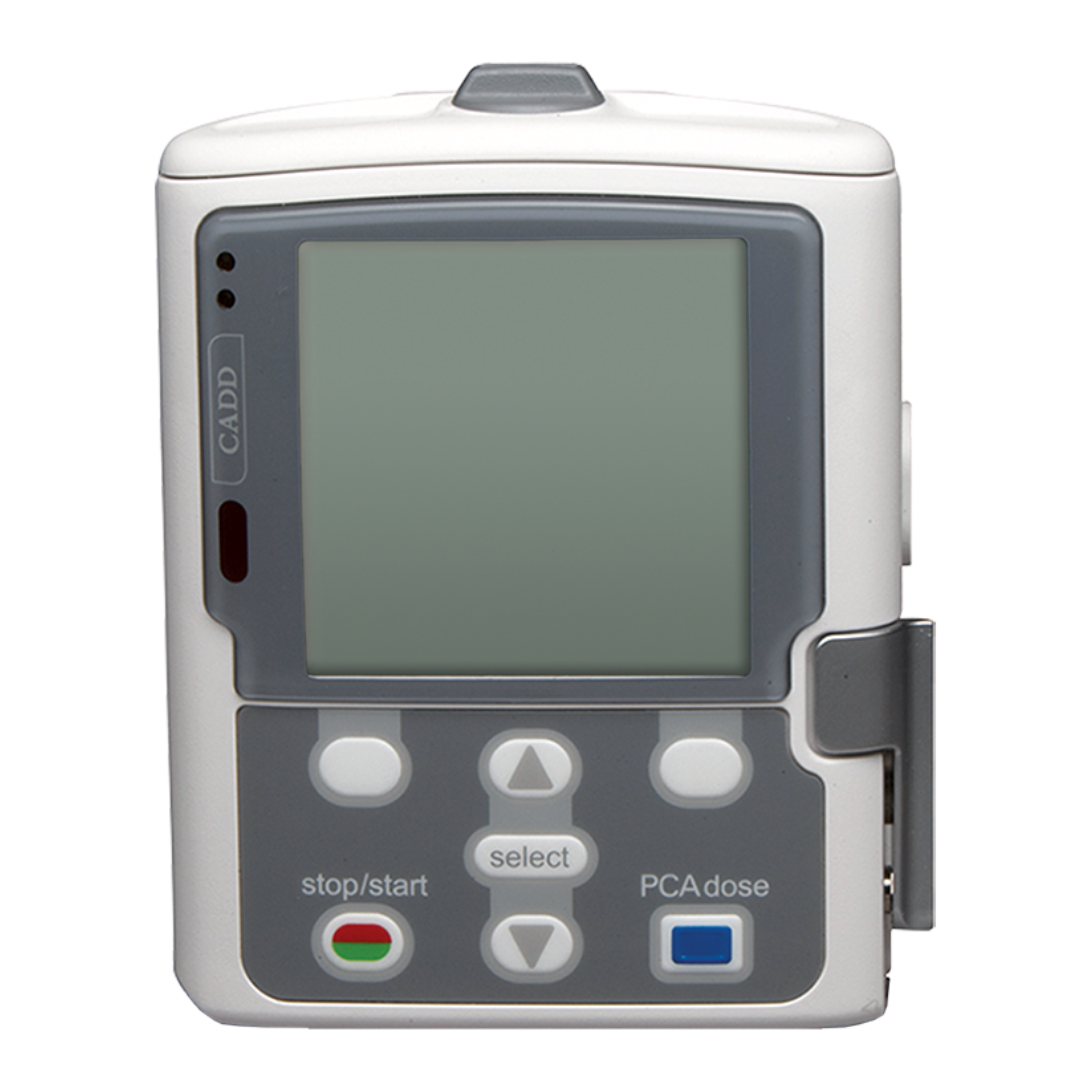
CADD Solis VIP 2120
The CADD®-Solis VIP 2120 is Smiths Medical’s variable infusion profile ambulatory pump — a compact, cassette-based piston pump built specifically for complex home infusion and outpatient therapy programs that require more than simple on/off delivery. Where the CADD-Solis 2110 focuses on hospital-based PCA and continuous infusion, the VIP 2120 is designed around the fuller range of programmable delivery profiles that home infusion pharmacies, specialty pharmacy programs, and outpatient clinics depend on: PCA, continuous, intermittent, variable step rate, and taper — five modes, each programmable individually or in combination, with a 500-protocol on-board library that adapts to virtually any prescribed regimen.
The “VIP” designation stands for Variable Infusion Profile, reflecting the two modes that set this pump apart from the standard Solis 2110: Step delivery, which automatically escalates the infusion rate to a programmed ceiling over a specified total volume, and Taper delivery, which provides a plateau rate with optional ramp-up and ramp-down periods plus a programmable KVO (keep vein open) rate at the end of the infusion.
IPR Medical buys, sells, repairs, and stocks parts and administration sets for the CADD-Solis VIP 2120. Contact us at 855-477-8866 or cs@iprmed.com.
CADD®-Solis VIP 2120 — Specifications
| Manufacturer | Smiths Medical ASD, Inc.; now marketed and supported by ICU Medical following 2022 acquisition |
| Model | CADD®-Solis VIP 2120 (Variable Infusion Profile) — non-wireless ambulatory infusion pump optimized for home infusion and outpatient specialty therapy |
| Software Version | v1.6 — corrected version per Class I FDA recall. Pumps on earlier software versions must be updated. Available in three configurations: PharmGuard® Software Enabled, Select Protocols, and Standard Settings. |
| Device Type | Piston-driven cassette ambulatory infusion pump; non-wireless; splashproof (IPX4 per IEC 60529) |
| Primary Use Setting | Home care (patient and/or caregiver-operated with proper training and clinical support); hospital and outpatient settings |
| Indications | Intravenous (IV), intra-arterial, subcutaneous (SQ), intraperitoneal, perineural (in close proximity to nerves), intraoperative (soft tissue / surgical wound site), epidural space, subarachnoid space. Not for intra-articular use. Not for blood or cellular blood products. |
| Delivery Modes (5) | PCA (patient-controlled analgesia / demand dose); Continuous (constant programmed rate); Intermittent (specific volume at regular programmed intervals with optional delayed start); Step (incremental rate escalation to specified maximum rate over specified total volume); Taper (plateau rate with optional ramp-up / ramp-down and programmable KVO rate at infusion end). All modes programmable individually or in combination. |
| VIP-Exclusive Modes | Step delivery and Taper delivery are unique to the VIP 2120 and are not available on the standard CADD-Solis 2110. These modes support complex therapy profiles including TPN, oncology, immunoglobulin, and opioid rotation protocols. |
| Continuous Rate Range (ml mode) | 0–100.00 ml/h in 0.1 ml/h increments |
| Bolus / PCA Volume (ml mode) | 0–50 ml in 0.05 ml increments (ml mode); mg and mcg ranges are concentration-dependent per scroll range tables in OEM Technical Manual |
| Reservoir Volume Programming | Programmable in 1 ml increments; displayed in 0.1 ml increments |
| KVO Rate | Programmable keep-vein-open rate available in taper mode to maintain catheter patency at end of infusion; only active when delayed start is programmed |
| Drug Units Supported | mL, mg, mcg; programming units preset through PharmGuard® software when used in protocol library mode; manual mode uses selected units |
| System Delivery Accuracy | ±6% (nominal); an additional ±5% change may be seen at ±100 mmHg (±1.9 psi) back pressure. Accuracy beyond ±6% may occur with back pressure, viscosity, catheter size, microbore tubing, or in-line filters. |
| Resolution | 0.050 ml per pump stroke (standard cassette or standard administration set); 0.10 ml per pump stroke (high-volume administration set) |
| Maximum Infusion Pressure | 1.86 bar (27 psi) |
| High Pressure Alarm Threshold | 1.24 ± 0.62 bar (18 ± 9 psi); two downstream occlusion sensitivity settings: High (immediate alarm at threshold) and Low (2-second delay to allow pressure stabilization) |
| Upstream Occlusion Sensor | Feature On/Off (configurable); automatically disabled when using medication cassette reservoirs; active when using CADD® administration sets |
| Air Detector Sensitivity | High: single bubble >150 mcL; Low: single bubble >400 mcL; Off. Accumulated air: >1 ml over 15 minutes (nominal). High sensitivity / filtered sets recommended for patients at risk of air embolism. |
| Max Volume Under Single-Fault Conditions | 0.15 ml (standard CADD® administration set); 0.30 ml (high-volume administration set) |
| Delivery Rate During Priming | ~250 ml/h (standard volume administration set); ~500 ml/h (high-volume administration set). Air-in-line alarm disabled during priming. |
| Protocol Library | On-board library stores up to 500 protocols. PharmGuard® configuration: therapy + qualifier + drug/concentration. Qualifiers include pediatric, TPN, epidural, and others. PharmGuard® Administrator Medication Safety Software (DERS) provides hard and soft limit guardrails. Three library configurations: PharmGuard® Enabled, Select Protocols (factory library pre-loaded), Standard Settings (manual mode, no library). |
| Compatible Reservoirs & Sets | CADD™ medication cassette reservoirs (50–250 ml); flexible IV bags up to 3 L (with CADD® high-volume administration set); CADD® extension sets; CADD® administration sets (standard and high-volume); Flow Stop variants available. IPR Medical stocks CADD cassette reservoirs and administration sets for the CADD-Solis VIP 2120. |
| Security Levels | 3 levels: Patient (keypad code), Clinician (clinician code — adds clinician bolus), Administrator (full programming and library management). All codes customizable. Autolock: 30 seconds on home screen; up to 4 minutes on programming screens. |
| Display | 320×320 pixel color LCD with backlighting; color-coded by therapy type and pump status; indicator lights: amber (stopped / alarm / low battery), green (running / delivering), blue (AC power) |
| Connectivity | Mini-B USB port for communication with PharmGuard® software (no wireless module on the 2120 — wireless is specific to the CADD-Solis 2110 model) |
| Power Sources | 4 × AA alkaline batteries (1.5V; NiCd, NiMH, and carbon zinc must NOT be used); CADD®-Solis rechargeable Li-ion battery pack; AC adapter |
| Rechargeable Battery Pack | Li-ion; 5.2 Wh capacity; minimum 500 charge/discharge cycles; charges fully in 4 hours or less within operating temp range (via AC adapter in pump or external). See FDA correction (Jul 2024) for battery pack inspection requirements. |
| Internal Memory Backup Battery | Lithium manganese dioxide; recharges whenever pump is powered on; 10-month memory backup capacity; maintains time/date for delivery logs, delayed starts, and PM alarms |
| Battery Fallout Alarm | Alarm sounds 2 minutes if pump powered on ≥4 minutes when batteries removed (run mode only) |
| Weight | 595 g (21 oz / 1.31 lbs) including 4 AA alkaline batteries, excluding cassette and accessories |
| Dimensions (W × H × D) | 4.1 cm × 10.2 cm × 12.7 cm (1.6″ × 4″ × 5″), excluding cassette and accessories |
| Moisture Protection | Splashproof (IPX4 per IEC 60529). Do not immerse pump in water or cleaning fluid. |
| Operating Environment | Temperature: 36°F–104°F (2°C–40°C); Humidity: 20%–90% non-condensing; Atmospheric Pressure: 70–106 kPa (10.2–15.4 psi) |
| Storage / Transport Environment | Temperature: −4°F–140°F (−20°C–60°C); do not store with cassette or administration set attached; do not store with batteries installed for prolonged periods. If stored outside operating conditions, allow 1 hour for temperature equilibration before use. |
| Electrical Classification | Type CF; Class II |
| MRI Compatibility | NOT MRI compatible. Remove pump from patient before MRI. Exposure to magnetic fields exceeding the 600 gauss line may cause irreversible damage. |
| Preventive Maintenance | Annual inspection and functional testing recommended per OEM Technical Manual. All servicing and repair must be performed by ICU Medical (formerly Smiths Medical) or authorized agents. IPR Medical performs authorized repair and maintenance. |
| Accessories | AC Adapter; Rechargeable Li-ion Battery Pack; Remote Dose Cord; Pump Key; Polemount Bracket / Adapter / Swivel; Pouches and Backpacks; PharmGuard® Administrator Medication Safety Software |
| FDA Device Corrections / Recalls | Multiple Class I corrections on record: software recall for versions earlier than v1.6 (FDA ID 208401, Aug 2024); CADD administration sets and cassette reservoirs — green Flow Stop arm occlusion / under-delivery (Dec 2022); Li-ion rechargeable battery pack — damage / internal short risk (Jul 2024); false upstream occlusion alarm with CADD administration sets (Apr 2025); additional alarm, thermal damage, and connection issues (Jun 2025, FDA ID 213276); FDA warning letter to ICU Medical for unauthorized device modifications (Apr 2025). See Tab 2 and FDA resources for full details. |
IPR Medical buys, sells, repairs, and stocks parts and administration sets for the CADD®-Solis VIP 2120. Contact us at 855-477-8866 or cs@iprmed.com.
Trademark Notice: Smiths Medical, and all other brand names, model names, and part numbers shown are trademarks of their respective owners and are used on this page only to identify the original manufacturer’s equipment offered here, consistent with nominative fair use. This listing is offered by IPR Medical, an ISO 9001:2015-certified independent service organization, and is not sponsored by, affiliated with, or endorsed by Smiths Medical.
Overview
The CADD®-Solis VIP 2120 is the Variable Infusion Profile model in the CADD-Solis ambulatory pump family from Smiths Medical — a non-wireless, cassette-based piston pump purpose-built for the complex, patient-managed therapy programs that define home infusion and specialty outpatient care. Originally manufactured and distributed by Smiths Medical ASD, Inc. and now marketed and supported by ICU Medical following their 2022 acquisition, the VIP 2120 is widely used by home infusion pharmacies, specialty pharmacy programs, outpatient oncology infusion centers, and pain management clinics that need a portable, accurate platform capable of managing more than basic continuous or demand-dose delivery. The FDA has confirmed that the CADD-Solis VIP pumps are specifically intended for home care use — patients and caregivers operating the device with proper training and ongoing clinical support — which distinguishes the VIP 2120’s design philosophy from the hospital-centric CADD-Solis 2110.
The key distinction embedded in the “VIP” name is two delivery modes not found on the standard CADD-Solis 2110: Step delivery and Taper delivery. Together with PCA, continuous, and intermittent modes, these five programmable profiles give the VIP 2120 the flexibility to manage a much wider range of therapy types — from opioid PCA at home post-discharge, to cyclic TPN, to antibiotics with intermittent dosing, to immunoglobulin infusions with rate escalation protocols, to opioid rotation using tapered rate reductions.
The Five Delivery Modes — What VIP Adds
PCA mode delivers medication at a continuous background rate and/or on patient demand via the Remote Dose Cord, with configurable lockout intervals and hourly limits to maintain safety. Continuous mode delivers at a constant programmed rate without demand dosing. Intermittent mode delivers a specific volume at regular, programmed intervals — useful for antibiotic dosing, cyclic hydration, and other scheduled therapy profiles that require periodic infusion rather than continuous delivery. A delayed start option allows the next dose start time to be scheduled in advance, enabling evening or overnight therapy to begin automatically without caregiver intervention.
Step delivery is unique to the VIP 2120 and automates the rate escalation that many therapies require. Rather than a clinician needing to manually reprogram the pump as the patient tolerates higher rates, the Step mode allows a starting rate, a maximum rate, and a total volume to be programmed in advance — the pump then increments through the rate escalation automatically. This is clinically valuable for immunoglobulin infusions, where rate titration protocols are standard, and for any therapy where slow initial rates are required for safety before higher rates are appropriate.
Taper delivery provides a plateau rate with an optional ramp-up at the beginning and/or ramp-down at the end, plus a programmable KVO (keep vein open) rate once the plateau infusion is complete. This profile is foundational for TPN programs (where a gradual ramp and ramp-down prevent metabolic complications from abrupt glucose changes), for opioid rotation protocols, and for any therapy where the clinical prescription includes a specific infusion curve rather than a flat rate. The “Taper Down Now” task allows a clinician to initiate an early ramp-down of the current plateau rate on demand — without reprogramming the full protocol — which is useful when a patient needs to end an infusion earlier than scheduled.
PharmGuard® Drug Library and DERS
The VIP 2120 is available in three software configurations: PharmGuard® Software Enabled (allows custom drug library download from PharmGuard® Administrator Medication Safety Software), Select Protocols (factory library pre-loaded with additional safety limits), and Standard Settings (manual mode programming with no library guardrails). The PharmGuard® configuration is the most commonly deployed in organized home infusion and specialty pharmacy programs, where pharmacy staff upload patient-specific or formulary-based protocol libraries containing hard and soft guardrails for each drug and therapy type. Protocol libraries can store up to 500 protocols on-board.
Each protocol is structured around a therapy (corresponding to one of the five delivery modes), a qualifier (which further identifies the infusion context — examples include pediatric, TPN, epidural, or oncology), and a drug/concentration entry. This structure allows the library to enforce clinically validated rate and dose limits at the point of programming, reducing the risk of errors when caregivers or patients reprogram the pump between infusion cycles at home. The PharmGuard® Administrator software, loaded on a pharmacy or clinic workstation, manages the library and pushes updates to pumps via USB connection.
Color Display, Security, and Home-Use Design
The VIP 2120’s 320×320 pixel color LCD displays therapy status, alarm messages, delivery progress, and reservoir volume in a format designed to be interpretable by caregivers and patients at home — not just trained clinical staff. The display uses color to communicate pump state: therapy-specific colors for each delivery mode, distinct colors for running versus alarming states, and a blue AC power light visible from across a room. Color coding significantly reduces the risk of misidentifying a pump state in a home environment where clinical monitoring infrastructure is not present.
Security is managed across three levels: the patient-level keypad code provides access to basic pump status viewing and PCA demand dosing; the clinician code adds access to clinician bolus delivery and protocol selection; and the administrator code allows full programming and library management. The autolock feature re-locks the keypad 30 seconds after the last keypress on the home screen and up to 4 minutes after the last keypress on programming or task screens, preventing unauthorized access to programming functions during the typical delays in a home care workflow. A physical cassette/keypad lock, activated with the supplied pump key, secures the cassette to the pump and can be configured to also lock the keypad — preventing a patient from detaching the reservoir or accessing programming without staff involvement.
Cassette Reservoirs, Administration Sets, and Consumables
The CADD-Solis VIP 2120 uses the same CADD™ medication cassette reservoir ecosystem as the 2110: 50 ml to 250 ml self-contained cassette reservoirs that lock directly onto the pump, or flexible IV bags up to 3 liters via CADD® high-volume administration sets. The cassette lock mechanism and tamper-resistant design of the reservoir system are particularly valuable in home care settings, where medication security over extended infusion periods is a primary concern — especially for opioid-containing reservoirs in PCA and pain management programs.
All CADD administration sets and cassette reservoirs with the green Flow Stop feature must be carefully primed and inspected before use, following the Dec 2022 Class I correction (see FDA section below). IPR Medical stocks CADD cassette reservoirs and administration sets for the CADD-Solis VIP 2120, providing home infusion pharmacies and specialty pharmacy programs a reliable single-source supply for their pump service and consumable needs.
Battery, Power, and Portability
The VIP 2120 runs on four AA alkaline batteries (NiCd, NiMH, and carbon zinc batteries must not be used), an optional CADD-Solis rechargeable Li-ion battery pack, or the supplied AC adapter. The rechargeable battery pack holds 5.2 Wh, sustains a minimum of 500 charge/discharge cycles, and charges fully in 4 hours or less within operating temperature range — either inside the pump with AC adapter attached or externally via the adapter directly. At 595 g including batteries, the pump is designed to be worn in a pouch, belt pack, or backpack throughout the patient’s normal daily routine. Smiths Medical-designed CADD pouches and backpacks accommodate the pump with either a cassette reservoir or IV bag and are specifically designed to prevent tubing kinks and strain that could affect delivery accuracy.
Battery life varies significantly by delivery rate. The OEM Technical Manual includes battery life tables for both alkaline AA batteries and the rechargeable pack at multiple delivery rates, which should be consulted when prescribing therapy regimens for home patients who will be away from AC power for extended periods. Alkaline battery storage at temperatures below 50°F significantly reduces capacity, an important consideration for patients in cold climates or those who store pump supplies in unheated spaces.
FDA Device Corrections and Safety Bulletins
The CADD-Solis VIP 2120 has a substantial and active FDA correction history. All corrections listed below are Class I — the most serious type, indicating that use without correction may cause serious injury or death. Facilities, home infusion pharmacies, and specialty pharmacy programs operating the VIP 2120 must be current on all corrections.
1. Software Recall — CADD-Solis VIP Versions Earlier Than v1.6 (FDA ID 208401, Aug 2024): ICU Medical (Smiths Medical) issued a Class I correction for all CADD-Solis VIP pumps running software versions earlier than v1.6 due to multiple software issues that may cause delay, interruption, under-administration, or over-administration of therapy. Software v1.6 is the current corrected version. An earlier Urgent Medical Device Correction Letter (Feb 27, 2024) addressed a subset of these issues; those corrections were carried forward into v1.6. Facilities must verify all VIP 2120 pumps are on v1.6 and update any units on prior software via USB connection with PharmGuard® Administrator software. IPR Medical can assist in verifying software version compliance.
2. CADD Administration Sets and Cassette Reservoirs — Green Flow Stop Arm Occlusion (Class I, Dec 2022): Smiths Medical recalled certain CADD administration sets and cassette reservoirs after manufacturing variations caused the green Flow Stop arm to potentially partially occlude tubing before clinical use. When the occlusion does not resolve upon connection to the pump, the pump may not detect it — resulting in under-delivery or non-delivery while displaying normal infusion status. For life-sustaining medications, alternative CADD infusion sets are recommended. All sets must be visually inspected during priming: if fluid does not flow normally or priming takes longer than expected, replace the set immediately.
3. Li-ion Rechargeable Battery Pack — Damage / Internal Short Risk (Class I, Jul 2024): ICU Medical issued a Class I correction for CADD-Solis Li-ion rechargeable battery packs. Physical damage to the battery pack casing may lead to an internal short circuit that melts the casing and prevents the battery from charging. All rechargeable battery packs must be inspected for outer case damage before use. Damaged packs must be replaced with a new rechargeable battery pack or four AA alkaline batteries before placing the pump in service.
4. False Upstream Occlusion (USO) Alarm — CADD Administration Sets (Class I, Apr 2025): ICU Medical identified a condition in which CADD-Solis and CADD-Solis VIP pumps may trigger an erroneous high-priority Upstream Occlusion alarm when all of the following are present: a CADD administration set is attached (not a cassette reservoir); the upstream occlusion alarm is enabled; KVO or continuous rate is not programmed; and more than one hour has elapsed between the first prime or infusion and the next. The USO alarm stops the infusion until cleared. Corrective action: be aware of the triggering conditions; if the alarm occurs, remove the administration set, re-attach, and restart. Using medication cassette reservoirs or enabling KVO/continuous rate eliminates this risk.
5. Additional Alarm, Thermal Damage, and Connection Issues (Class I, Jun 2025, FDA ID 213276): The FDA identified additional Class I corrections for both the CADD-Solis and CADD-Solis VIP platforms covering a false occlusion alarm issue, a thermal damage concern, and an intermittent connection issue — all of which may result in interruptions or therapy delays. Facilities should access the FDA Medical Device Recalls Database to verify their specific pump serial numbers against the affected product list for this correction and follow ICU Medical’s updated use instructions.
6. FDA Warning Letter to ICU Medical (Apr 2025): The FDA issued a warning letter to ICU Medical after a July–August 2024 inspection found that the company had implemented software updates to the CADD-Solis VIP intended to address safety concerns without submitting the required 510(k) premarket notifications. The CADD-Solis VIP was one of the two devices specifically named in the warning letter. ICU Medical has stated that new 510(k) submissions for the CADD-Solis VIP are in progress. Facilities should verify the current regulatory status of software v1.6 directly with ICU Medical.
Action recommended: All facilities and home infusion programs operating CADD-Solis VIP 2120 pumps should immediately verify software version on all units and update any pump not running v1.6. Inspect all Li-ion rechargeable battery packs for outer case damage and replace any damaged packs before use. Inspect all CADD administration sets and cassette reservoirs for proper fluid flow during priming before clinical use. Be aware of the conditions that trigger the false USO alarm when using CADD administration sets, and consider switching to cassette reservoirs for life-sustaining therapies. Verify pump serial numbers against the FDA ID 213276 affected list. Contact ICU Medical (Smiths Medical) at 1-800-241-4002 or TSC.Support@icumed.com for recall response support. Contact IPR Medical at 855-477-8866 or cs@iprmed.com for service and parts assistance.
Because FDA device corrections and safety communications may be updated or expanded after the date of this listing, IPR Medical recommends that facilities also check the FDA’s official resources directly to ensure they have the most current information:
IPR Medical — Your Source for the CADD-Solis VIP 2120
IPR Medical buys, sells, repairs, and stocks parts and administration sets for the CADD®-Solis VIP 2120. Whether your home infusion program or specialty pharmacy needs refurbished pump units, replacement cassette reservoirs and administration sets, Li-ion battery pack replacements, annual preventive maintenance and calibration service, or guidance navigating the multiple active Class I corrections on this platform, our team has the expertise and inventory to help. We can assist in verifying software version compliance across your pump fleet and sourcing alternative CADD consumables for patients on life-sustaining therapy programs affected by the Dec 2022 Flow Stop recall.
IPR Medical buys, sells, repairs, and stocks parts and administration sets for the CADD®-Solis VIP 2120. Contact us at 855-477-8866 or cs@iprmed.com.
Trademark Notice: Smiths Medical, and all other brand names, model names, and part numbers shown are trademarks of their respective owners and are used on this page only to identify the original manufacturer’s equipment offered here, consistent with nominative fair use. This listing is offered by IPR Medical, an ISO 9001:2015-certified independent service organization, and is not sponsored by, affiliated with, or endorsed by Smiths Medical.
| Weight | 1.5 lbs |
|---|---|
| Dimensions | 4 × 2 × 5 in |
- Lock Box
- AC Adapter
- Key
- Bolus Cord
- Patient Cable
You may also like…

Curlin Painsmart IOD
Original price was: $1,095.00.$995.00Current price is: $995.00.

Related Products
Curlin 6000 CMS
Original price was: $1,695.00.$1,495.00Current price is: $1,495.00.

Curlin Painsmart IOD PCA
Original price was: $1,095.00.$995.00Current price is: $995.00.


Reviews
There are no reviews yet.