

CADD Solis 2110
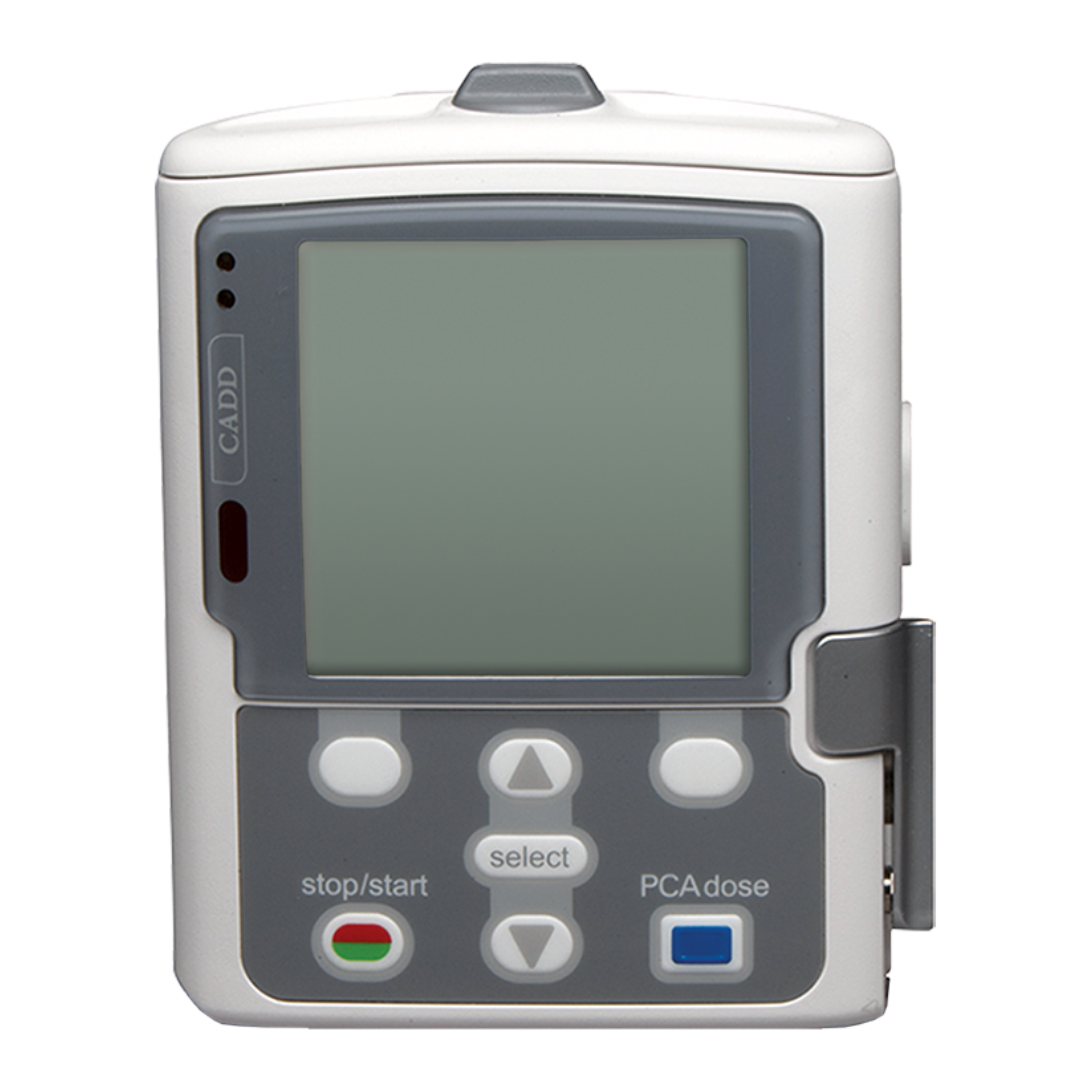
The CADD®-Solis 2110 is Smiths Medical’s wireless-capable ambulatory infusion pump — a compact, cassette-based piston pump designed to deliver precise, programmable drug therapy across a wide range of clinical settings, from hospital inpatient units and surgical suites to outpatient pain clinics and home infusion programs. The CADD-Solis 2110 is the wireless variant of the CADD-Solis platform (distinguished from the non-wireless 2100 model by its support for the optional CADD-Solis Communication Module). It is cleared for intravenous, intra-arterial, subcutaneous, intraperitoneal, perineural, intraoperative, epidural, and subarachnoid infusion — covering virtually every ambulatory and acute infusion route outside of intra-articular space.
At just 21 oz with four AA batteries installed, the 2110 fits in a patient pouch or backpack and travels with the patient throughout their care. It delivers at a continuous rate from 0 to 100 ml/h (in ml mode), supports patient-controlled analgesia (PCA/PCEA) demand dosing, intermittent bolus (IB) programming, clinician bolus, and Programmed Intermittent Bolus (PIB) — all combinable in a single protocol.
IPR Medical buys, sells, repairs, and stocks parts and administration sets for the CADD-Solis 2110. Contact us at 855-477-8866 or cs@iprmed.com.
CADD®-Solis 2110 — Specifications
| Manufacturer | Smiths Medical ASD, Inc. (now marketed and supported by ICU Medical following 2022 acquisition |
| Model | CADD®-Solis 2110 — wireless-enabled ambulatory infusion pump (wireless Communication Module sold separately) |
| Current Software Version | v4.2 (Software Package # 97-0582-0402XX-01) — corrected version per Class I FDA recall. Pumps on earlier software versions must be updated. Field-upgradeable via SureLink® Remote Support Software. |
| Device Type | Piston-driven cassette ambulatory infusion pump; wireless-capable (model 2110); splashproof |
| Indications | Intravenous (IV), intra-arterial, subcutaneous (SQ), intraperitoneal, perineural (in close proximity to nerves), intraoperative (soft tissue / surgical wound site), epidural space, subarachnoid space. Continuous rate, intermittent bolus (IB), and/or patient-controlled demand dose (PCA/PCEA). Not for intra-articular use. Not for blood or cellular blood products. |
| Delivery Modes | Continuous Rate; Intermittent Bolus (IB); PCA / PCEA Demand Dose; Clinician Bolus; Programmed Intermittent Bolus (PIB). All modes may be programmed individually or in combination. |
| Continuous Rate Range (ml mode) | 0–100.00 ml/h in 0.1 ml/h increments |
| Bolus / PCA / IB Volume (ml mode) | 0–50 ml in 0.05 ml increments |
| Drug Units Supported | mL, mg, mcg; mg and mcg ranges are concentration-dependent (see scroll range tables in OEM Technical Manual) |
| System Delivery Accuracy | ±6% (nominal). Accuracy test results from OEM: minimum error −2.9%, maximum error +4.5%. Accuracy beyond ±6% may occur with back pressure, viscosity, catheter size, microbore tubing, in-line components, or reservoir/pump height differential. |
| Resolution | 0.050 ml per pump stroke (standard cassette or standard administration set); 0.10 ml per pump stroke (high-volume administration set) |
| Maximum Infusion Pressure | 1.86 bar (27 psi) |
| High Pressure Alarm Threshold | 1.24 ± 0.62 bar (18 ± 9 psi) |
| Air Detector Sensitivity | Low sensitivity: single bubble >400 mcL; High sensitivity: single bubble >150 mcL; Accumulated air: >1 ml over 15 minutes (nominal). High sensitivity / filtered sets recommended for patients at risk of air embolism. |
| Max Volume Under Single-Fault Conditions | 0.15 ml (standard CADD® administration set); 0.30 ml (high-volume administration set) |
| Delivery Rate During Priming | ~250 ml/h (standard cassette tubing); 500 ml/h (high-flow cassette tubing). Air-in-line alarm disabled during priming. |
| Compatible Reservoirs & Sets | CADD™ medication cassette reservoirs (50–250 ml); flexible IV bags up to 3 L (with CADD® high-volume administration set); CADD® extension sets; CADD® administration sets (standard and high-volume); Flow Stop variants available. IPR Medical stocks CADD cassette reservoirs and administration sets for the CADD-Solis 2110. |
| Security Levels | 3 levels: Patient (keypad code), Clinician (clinician code — adds clinician bolus access), Administrator (full programming and library management). All codes customizable via PharmGuard® software. Autolock configurable. Cassette/keypad lock available. |
| Drug Library / DERS | PharmGuard® Medication Safety Software (DERS); PharmGuard® Server Software for enterprise library management. Protocol libraries downloadable to pump. Wireless library updates via CADD-Solis Communication Module (2110 only). |
| Wireless Capability | Model 2110: wireless-enabled via optional CADD®-Solis Communication Module (with integrated rechargeable battery). Supports wireless library updates, firmware deployment, and device tracking. CADD-Solis Network Setup Utility required for network configuration. |
| Software Upgradeability | Field-upgradeable via SureLink® Remote Support Software (PC Direct Connect via USB). Updates obtained from ICU Medical (formerly Smiths Medical) Customer Service via internet. Current required version: v4.2. |
| Display | Color LCD with backlighting; adjustable backlight intensity; indicator lights: amber, green, and blue (AC power) |
| Reports & Logs | Delivery Log; Event Log; IB Status; PCA/PCEA Dose Graph and Counters; IB Graph; Delivery History and Pie Chart; Protocol Library Summary; Wireless Status and Settings; Device Information |
| Power Sources | 4 × AA alkaline batteries (Duracell® PC1500 / MN1500, IEC LR6 recommended); AC adapter; CADD®-Solis rechargeable Li-ion battery pack. Note: NiCd, NiMH, and carbon zinc (“heavy duty”) batteries must NOT be used. |
| Internal Memory Backup Battery | Lithium manganese dioxide; charges whenever pump is powered on; 10-month memory capacity after 250 hours of charge at 68°F (20°C) |
| Battery Fallout Alarm | Alarm sounds for 2 minutes if pump has been powered on for a minimum of 4 minutes when batteries are removed (run mode only) |
| Weight | 595 g (21 oz / 1.31 lbs) including 4 AA alkaline batteries, excluding cassette and other accessories |
| Dimensions (W × H × D) | 4.1 cm × 10.2 cm × 12.7 cm (1.6″ × 4″ × 5″), excluding cassette and accessories |
| Moisture Protection | Splashproof (E) per IEC 60529. Do not immerse pump in water or cleaning fluid. |
| Operating Environment | Temperature: 59°F–104°F (15°C–40°C); Humidity: 20%–90% non-condensing; Atmospheric Pressure: 70–106 kPa (10.2–15.4 psi) |
| Storage / Transport Environment | Temperature: −4°F–140°F (−20°C–60°C); do not store with cassette or administration set attached; do not store with batteries installed for prolonged periods |
| Electrical Classification | Type CF; Class II |
| MRI Compatibility | NOT MRI compatible. Remove pump from patient prior to MRI. Exposure to magnetic fields exceeding the 600 gauss line may cause irreversible damage. |
| Preventive Maintenance | Annual inspection and functional testing recommended per OEM Technical Manual. |
| Accessories | AC Adapter; Rechargeable Li-ion Battery Pack; CADD®-Solis Communication Module (wireless, 2110 only); Pump Key; Remote Dose Cord; Polemount Bracket / Adapter / Swivel; Pouches and Backpacks; LockBox; PharmGuard® Medication Safety Software; PharmGuard® Server Software; SureLink® Remote Support Software; CADD-Solis Network Setup Utility |
| FDA Device Corrections / Recalls | Multiple Class I corrections on record: software recall for versions earlier than v4.2 (FDA ID 208401, Aug 2024); CADD administration sets and cassette reservoirs — green Flow Stop arm occlusion / under-delivery (Dec 2022); Li-ion rechargeable battery pack — damage / internal short risk (Jul 2024); false upstream occlusion alarm with CADD administration sets (Apr 2025); wireless network compatibility alarm (Apr 2025). See Tab 2 and FDA resources for full details. |
IPR Medical buys, sells, repairs, and stocks parts and administration sets for the CADD®-Solis 2110. Contact us at 855-477-8866 or cs@iprmed.com.
Trademark Notice: Smiths Medical, and all other brand names, model names, and part numbers shown are trademarks of their respective owners and are used on this page only to identify the original manufacturer’s equipment offered here, consistent with nominative fair use. This listing is offered by IPR Medical, an ISO 9001:2015-certified independent service organization, and is not sponsored by, affiliated with, or endorsed by Smiths Medical.
Overview
The CADD®-Solis 2110 is Smiths Medical’s wireless-capable model in the CADD-Solis ambulatory infusion pump family — a compact, piston-driven cassette pump engineered for precise, programmable drug delivery across an exceptionally broad range of clinical settings and infusion routes. Originally developed by Smiths Medical ASD, Inc. and now marketed and supported by ICU Medical following their 2022 acquisition, the CADD-Solis 2110 is used in post-operative pain management, oncology, labor and delivery analgesia, home infusion, critical care, and palliative therapy programs. The “2110” model number specifically designates the wireless-enabled variant of the platform, distinguishing it from the non-wireless 2100 by its support for the optional CADD-Solis Communication Module, which enables over-the-air drug library updates, firmware deployment, and fleet tracking without requiring physical connection to each pump.
The pump’s clinical breadth is a defining characteristic. The CADD-Solis 2110 is cleared for intravenous, intra-arterial, subcutaneous, intraperitoneal, perineural, intraoperative (soft tissue and surgical wound site), epidural space, and subarachnoid space delivery — covering essentially every ambulatory infusion route outside of intra-articular space. This makes the 2110 a single-platform solution for facilities that manage diverse ambulatory therapy programs, from routine post-surgical IV analgesia to epidural labor analgesia and complex home chemotherapy.
Delivery Modes and Programming Flexibility
The CADD-Solis 2110 supports four delivery modes that can be programmed individually or in combination within a single patient protocol: continuous rate (a constant programmed rate from 0 to 100 ml/h in ml mode), intermittent bolus (IB, a series of clinician-scheduled doses delivered automatically at programmed intervals), PCA/PCEA demand dose (patient-activated bolus via Remote Dose Cord, subject to lockout interval and hourly limits), and clinician bolus (an immediate dose activated by a clinician code, useful for loading doses or breakthrough management). Programmed Intermittent Bolus (PIB) is also supported, enabling clinicians to pre-schedule bolus deliveries before pain escalates — a technique that has demonstrated improved analgesic distribution and reduced total drug consumption in epidural labor analgesia programs.
Programming is structured around three security levels — patient (keypad code), clinician (clinician code), and administrator (administrator code) — each granting progressively deeper access to pump functions and protocol parameters. All security codes are customizable by the administrator via PharmGuard® software, and the autolock feature can be configured to lock the keypad after a defined period of inactivity. A physical cassette/keypad lock provides an additional layer of security for home-use settings where preventing patient access to programming functions is essential. The manual program mode, which bypasses protocol library limits, does not contain programming guardrails and requires careful clinician review before use.
PharmGuard® Drug Library and DERS
The CADD-Solis 2110 is integrated with PharmGuard® Medication Safety Software, Smiths Medical’s Dose Error Reduction Software (DERS) platform. PharmGuard allows pharmacy and clinical informatics teams to build, manage, and version-control protocol libraries that are pushed to pumps either via physical connection through SureLink® or over the air through the wireless Communication Module. Each protocol library entry defines drug name, concentration, therapy type, and configurable hard and soft limit guardrails for rate, dose, lockout interval, and hourly limit — preventing programming of values outside clinically approved ranges. PharmGuard® Server Software enables enterprise-scale library management across multiple sites or care units.
The pump’s delivery log and event log capture a comprehensive record of all infusion events, alarm conditions, security code entries, and programming changes, providing the audit trail that regulatory compliance and quality programs require. PCA dose graphs, IB status reports, and delivery history pie charts give clinicians at-a-glance visibility into therapy adherence and patient demand patterns without requiring external data extraction.
Wireless Capability and the Communication Module
The defining hardware difference between the 2110 and the non-wireless 2100 is support for the CADD-Solis Communication Module, an optional accessory that attaches to the pump and provides its own integrated rechargeable battery, wireless network connectivity, and the hardware necessary for bidirectional communication between the pump and the facility’s CADD network. With the Communication Module installed, the 2110 can receive drug library updates and firmware downloads over the hospital wireless network without requiring each pump to be physically transported to a programming station — a significant operational advantage in large fleet environments where library synchronization across hundreds of pumps would otherwise consume significant biomedical engineering time.
Wireless network compatibility is an ongoing operational consideration for CADD-Solis 2110 installations. Network setting changes or updates on the hospital infrastructure can disrupt communication between the pump and the Communication Module, triggering a high-priority alarm that stops the infusion. ICU Medical recommends validating any wireless network changes against the pump and Communication Module configuration before deploying to the production environment. See the FDA corrections section below for the specific 2025 correction notice on this issue.
Cassette Reservoirs, Administration Sets, and Consumables
The CADD-Solis 2110 uses CADD™ medication cassette reservoirs (available in 50 ml to 250 ml sizes) that lock directly onto the pump body, providing a self-contained, tamper-resistant drug reservoir. The locked cassette assembly helps maintain medication security throughout the infusion episode — a clinically important feature for ambulatory patients in home and outpatient settings where the pump and its reservoir may be out of direct clinical supervision for extended periods. For higher-volume applications, CADD® high-volume administration sets allow the pump to draw from flexible IV bags up to 3 liters, using a 0.10 ml/stroke resolution mechanism optimized for larger reservoir use.
All CADD administration sets and cassette reservoirs that incorporate the green Flow Stop feature should be carefully primed before use and inspected for proper fluid flow, following the Dec 2022 Class I correction (see FDA section below). IPR Medical stocks CADD cassette reservoirs and administration sets for the CADD-Solis 2110, providing facilities and home infusion pharmacies a single source for pump service and consumable supply needs.
Battery, Power, and Portability
The CADD-Solis 2110 is powered by four AA alkaline batteries (Duracell® PC1500 / MN1500 or equivalent IEC LR6 alkaline batteries recommended — NiCd, NiMH, and carbon zinc batteries must not be used), an optional rechargeable Li-ion battery pack, or an AC adapter. At 595 g (21 oz / 1.31 lbs) with batteries installed, the pump is light enough for ambulatory patients to carry in a pouch, belt pack, or backpack throughout their daily routine. Moog-style pump pouches and backpacks are available that accommodate the pump with either a cassette reservoir or a flexible IV bag, maintaining portability across the full range of reservoir formats.
The pump includes an internal memory backup battery using lithium manganese dioxide technology, which charges whenever the pump is powered on and maintains memory for up to 10 months following 250 hours of charge at 68°F. If the primary batteries are removed while the pump is running in a mode that has been powered for at least 4 minutes, the battery fallout alarm sounds for 2 minutes — alerting caregivers to a power interruption before drug delivery is lost.
FDA Device Corrections and Safety Bulletins
The CADD-Solis 2110 has a significant and active FDA correction history that all facilities operating the platform must be aware of. All confirmed corrections described below are Class I — the most serious type of recall, indicating that use of the affected products without correction may cause serious injury or death.
1. Software Recall — CADD-Solis Versions Earlier Than v4.2 (FDA ID 208401, Aug 2024): ICU Medical (Smiths Medical) issued a Class I correction for all CADD-Solis pumps running software versions earlier than v4.2. The recall covers multiple software issues related to outdated software that may cause delay, interruption, under-administration, or over-administration of therapy. Software v4.2 is the current corrected version and was also the version introduced following a February 2024 urgent medical device correction letter addressing an earlier subset of these issues. Facilities must verify that all CADD-Solis 2110 pumps are running v4.2 and coordinate updates for any units on older software via the SureLink® utility. IPR Medical can assist in verifying and coordinating software updates.
2. CADD Administration Sets and Cassette Reservoirs — Green Flow Stop Arm Occlusion (Class I, Dec 2022): Smiths Medical recalled certain CADD administration sets and cassette reservoirs due to manufacturing variations that may cause the green Flow Stop arm to partially occlude the tubing before clinical use. If the occlusion does not resolve when the affected reservoir or set is connected to the pump, the pump may not detect it — resulting in under-delivery or complete non-delivery of medication while the pump display shows the infusion running normally. A second issue in the same recall involved false “No Disposable Attached” (NDA) alarms on certain 50 ml and 700 ml cassette reservoirs with Flow Stop. Corrective actions: use alternative CADD infusion sets for life-sustaining medications; visually inspect all sets during priming; if fluid does not flow normally or priming takes longer than expected, replace the set. Affected lot numbers should be identified and quarantined.
3. Li-ion Rechargeable Battery Pack — Damage / Internal Short Risk (Class I, Jul 2024): ICU Medical issued a Class I correction for CADD-Solis Li-ion rechargeable battery packs due to a risk that physical damage to the battery pack may cause an internal short circuit that melts the pack casing and prevents the battery from accepting a charge. Corrective actions: inspect all CADD-Solis rechargeable battery packs for any evidence of outer case damage before use; do not use any damaged packs; replace damaged packs with a new CADD-Solis rechargeable battery pack or with four AA alkaline batteries.
4. False Upstream Occlusion (USO) Alarm — CADD Administration Sets (Class I, Apr 2025): ICU Medical identified a condition in which a CADD-Solis pump may trigger an erroneous high-priority Upstream Occlusion alarm when all of the following conditions are present: a CADD administration set (not a cassette reservoir) is attached, the set has been primed or infused, and there is a delay of more than one hour before the next infusion or prime. The USO alarm is a high-priority alarm that stops the infusion until cleared. This issue does not occur when using medication cassette reservoirs, when the USO alarm is disabled, or when a KVO or continuous rate is programmed. Corrective action: be aware of the conditions that trigger the false alarm; if it occurs, remove the administration set, re-attach it, and restart delivery. Switching to cassette reservoirs eliminates the risk.
5. Wireless Network Compatibility (Class I, Apr 2025): ICU Medical notified customers that CADD-Solis pumps may lose wireless communication with the Communication Module if hospital network settings change in ways that are incompatible with the module’s configuration. Loss of communication triggers a high-priority alarm that stops the infusion. Corrective action: validate all wireless network changes against the pump and Communication Module before deploying to the production environment; contact ICU Medical for guidance on compatible network configurations.
6. FDA Warning Letter to ICU Medical (2024): Following a July–August 2024 inspection of ICU Medical’s Minneapolis facility, the FDA issued a warning letter finding that the company had implemented software updates intended to address safety concerns without submitting the required 510(k) premarket notifications for those changes. ICU Medical responded that new 510(k) submissions for the CADD-Solis platform were in progress and committed to submitting them within 90 days of the warning letter. Facilities should verify with ICU Medical the current regulatory status of software v4.2.
Action recommended: All facilities operating CADD-Solis 2110 pumps should immediately verify software version on all units and update any pump not running v4.2 via SureLink®. Inspect all CADD administration sets and cassette reservoirs for proper fluid flow during priming before clinical use. Inspect all Li-ion rechargeable battery packs for outer case damage and replace any damaged packs before use. Validate wireless network configuration compatibility with the Communication Module before any network changes. Contact ICU Medical (formerly Smiths Medical) at 1-800-241-4002 or TSC.Support@icumed.com for recall response support. Contact IPR Medical at 855-477-8866 or cs@iprmed.com for service and parts assistance.
Because FDA device corrections and safety communications may be updated or expanded after the date of this listing, IPR Medical recommends that facilities also check the FDA’s official resources directly to ensure they have the most current information:
IPR Medical — Your Source for the CADD-Solis 2110
IPR Medical buys, sells, repairs, and stocks parts and administration sets for the CADD®-Solis 2110. Whether your facility needs refurbished pump units, replacement cassette reservoirs and administration sets for ongoing patient programs, Li-ion battery pack replacements, repair and annual preventive maintenance service, or assistance navigating the multiple active Class I corrections on this platform, our team has the expertise and inventory to support you. We can assist facilities in verifying software version compliance, coordinating SureLink® updates, and sourcing alternative CADD consumables for life-sustaining therapy programs affected by the Dec 2022 Flow Stop recall.
IPR Medical buys, sells, repairs, and stocks parts and administration sets for the CADD®-Solis 2110. Contact us at 855-477-8866 or cs@iprmed.com.
Trademark Notice: Smiths Medical, and all other brand names, model names, and part numbers shown are trademarks of their respective owners and are used on this page only to identify the original manufacturer’s equipment offered here, consistent with nominative fair use. This listing is offered by IPR Medical, an ISO 9001:2015-certified independent service organization, and is not sponsored by, affiliated with, or endorsed by Smiths Medical.
| Weight | 1.5 lbs |
|---|---|
| Dimensions | 4 × 2 × 5 in |
- Lock Box
- AC Adapter
- Key
- Bolus Cord
- Patient Cable
You may also like…

CADD Solis VIP 2120
Original price was: $1,995.00.$1,695.00Current price is: $1,695.00.
Curlin Painsmart IOD
Original price was: $1,095.00.$995.00Current price is: $995.00.
Related Products

Curlin 6000 CMS
Original price was: $1,695.00.$1,495.00Current price is: $1,495.00.
Curlin Painsmart IOD Epidural
Original price was: $1,095.00.$995.00Current price is: $995.00.

Reviews
There are no reviews yet.