


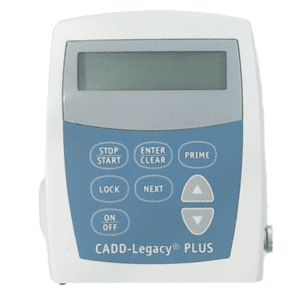
CADD Legacy PCA 6300
The Smiths Medical CADD-Legacy® PCA (Model 6300) is the dedicated pain management model in the CADD-Legacy® ambulatory infusion family, purpose-built for patient-controlled analgesia and clinician-managed analgesic protocols. It supports three delivery modes — a programmable continuous background infusion, a patient-activated demand dose via pump button or remote dose cord, and a clinician-administered bolus — giving the care team and patient precisely the level of control their protocol requires. The 6300 can be programmed in ml, mg, or mcg units with concentration entry, accommodating a wide range of opioid and non-opioid analgesic regimens across intravenous, subcutaneous, epidural, subarachnoid, and other routes.
System delivery accuracy is ±6% (nominal), weight is 0.86 lbs on two AA alkaline batteries, and battery life reaches approximately 40 hours at a moderate continuous rate of 30 ml/hr — or approximately 14 days at low-rate protocols — supporting home PCA patients between pharmacy or clinic visits. The 6300 shares the same 1,000-event downloadable audit trail, three-level security lock system, and full alarm suite as the rest of the CADD-Legacy® family.
IPR Medical buys, sells, repairs, and stocks parts and administration sets for the Smiths Medical CADD-Legacy® PCA (Model 6300). Contact us at 855-477-8866 or cs@iprmed.com.
Smiths Medical CADD-Legacy® PCA — Model 6300 Specifications
| Model Number | 6300 |
| Manufacturer | Smiths Medical (formerly SIMS Deltec, Inc.) |
| Pump Type | Ambulatory PCA (Patient-Controlled Analgesia) infusion pump |
| Delivery Modes | Continuous; Demand Dose (patient-activated PCA); Clinician Bolus |
| Continuous Rate Range | 0–125 ml/hr; programmable in 0.1 ml/hr increments (0 = continuous off, demand dose only) |
| Demand Dose | Programmable; patient-activated via pump keypad button or Remote Dose Cord accessory |
| Clinician Bolus | Up to 20 ml (or equivalent in mg or mcg); accessible via clinician security code only |
| Dose Lockout | Programmable by Dose Lockout time interval or Doses Per Hour limit — whichever is more restrictive governs |
| Programming Units | ml, mg, or mcg; concentration entry in mg/ml or mcg/ml for weight-based dosing |
| Reservoir Volume (programmable) | 1–9,999 ml or Not In Use; programmable in 1 ml increments, displayed in 0.1 ml increments |
| Compatible Reservoir Sizes | 50 ml, 100 ml, 250 ml CADD® Medication Cassette Reservoirs; CADD® Administration Sets for larger volumes |
| System Delivery Accuracy | ±6% (nominal); accuracy averages out over total infusion time |
| Delivery Resolution | 0.050 ml per pump stroke (nominal) |
| Maximum Infusion Pressure | 40.0 psi (2.76 bar) |
| Maximum Volume at Single Fault | 0.2 ml (CADD™ Administration Set) |
| Remote Dose Cord | Compatible — handheld button connects to accessory jack; allows patient to activate demand dose remotely |
| Power Source | 2 AA alkaline batteries (primary); optional AC adapter |
| Battery Life (nominal) | ~40 hours at 30 ml/hr continuous; ~14 days at 10 ml/day |
| Weight | 0.86 lbs (13.8 oz) including 2 AA batteries and empty medication reservoir |
| Operating Temperature | 35°F–104°F (2°C–40°C) |
| Storage Temperature | -4°F–140°F (-20°C–60°C) |
| Humidity | 20%–90% relative humidity (non-condensing) |
| Moisture Protection | Splashproof |
| Security / Lock Levels | 3 programmable lock levels (LL0–LL2); separate clinician bolus security code |
| Event Memory | Last 1,000 events including Doses Given and Doses Attempted; downloadable via CADD-DIPLOMAT® PC Communications System |
| Safety Features | Upstream & downstream occlusion sensors; air-in-line detector (Off/Low/High sensitivity); cassette detection sensor; demand-dose lockout; battery monitoring |
| Alarms | Low battery; depleted battery; battery dislodged; pump stopped; pump fault; low reservoir volume; high delivery pressure; air in line; disposable not attached; motor locked; upstream occlusion; reservoir volume empty; key stuck; disposable detached |
| Administration Sets | CADD® Medication Cassette Reservoirs and CADD® Administration Sets with anti-siphon valve; IPR Medical stocks CADD-compatible administration sets and reservoirs |
| Infusion Routes | Intravenous, intra-arterial, subcutaneous, intraperitoneal, epidural space, subarachnoid space |
| FDA Device Corrections | Class I correction (Jan. 2023) affecting CADD Administration Sets and Medication Cassette Reservoirs used with all CADD Legacy pumps |
IPR Medical buys, sells, repairs, and stocks parts and administration sets for the Smiths Medical CADD-Legacy® PCA (Model 6300). Contact us at 855-477-8866 or cs@iprmed.com.
Trademark Notice: Smiths Medical, and all other brand names, model names, and part numbers shown are trademarks of their respective owners and are used on this page only to identify the original manufacturer’s equipment offered here, consistent with nominative fair use. This listing is offered by IPR Medical, an ISO 9001:2015-certified independent service organization, and is not sponsored by, affiliated with, or endorsed by Smiths Medical.
Overview
The Smiths Medical CADD-Legacy® PCA (Model 6300) is a therapy-specific ambulatory infusion pump purpose-built for patient-controlled analgesia and complex pain management protocols. The dedicated PCA model in the CADD-Legacy® family, the 6300 combines a programmable continuous background infusion, patient-activated demand dosing, and a clinician-accessible bolus function — giving both the care team and the patient exactly the degree of therapeutic control their protocol requires. It is widely used for post-operative pain management, palliative care, oncology analgesia, chronic pain programs, and home-based PCA therapy. Smiths Medical discontinued sale of the CADD-Legacy® pump line effective December 31, 2022, but these pumps remain in active clinical service across pain management, home infusion, and specialty pharmacy settings, and IPR Medical fully supports the 6300 through sales, repair, and parts availability.
Delivery Modes and PCA Programming
The CADD-Legacy® PCA supports three delivery modes that can be used independently or in combination. In continuous mode, the pump delivers a steady background infusion at any rate from 0 to 125 ml/hr in 0.1 ml/hr increments — including zero, which allows demand-dose-only protocols without a basal infusion. The demand dose function allows the patient to self-administer a clinician-programmed bolus by pressing the PCA button on the pump keypad or a connected Remote Dose Cord, a handheld button that plugs into the pump’s accessory jack. This is particularly useful for patients with limited mobility or dexterity who wear the pump in a pouch. The dose lockout interval — controlled by either a timed lockout period or a maximum Doses Per Hour limit, with whichever is more restrictive governing — prevents patient over-administration between allowable doses. The Clinician Bolus function, protected by a separate security code distinct from the standard lock level codes, allows the care provider to administer an additional dose of up to 20 ml when clinically indicated. Programming can be performed in ml, mg, or mcg, with concentration entry in mg/ml or mcg/ml to support weight-based dosing. The pump tracks both Doses Given and Doses Attempted in its event memory, providing a complete compliance and audit trail downloadable via the CADD-DIPLOMAT® PC Communications System.
Safety and Alarm Features
The CADD-Legacy® PCA incorporates the same comprehensive safety architecture as the rest of the CADD-Legacy® family. Upstream and downstream occlusion sensors monitor the complete fluid path on both sides of the pump, halting delivery and triggering audible and visual alarms upon detection of any blockage. An air-in-line detector with three adjustable sensitivity settings (Off, Low, High) stops the pump if air is detected in the tubing. A cassette detection sensor verifies proper reservoir attachment before and during operation. Three programmable security lock levels (LL0–LL2) protect clinical programming from unauthorized patient access, and the separate Clinician Bolus security code prevents patients from accessing the bolus function even in lock levels that allow some rate adjustment. The demand-dose lockout system provides an additional layer of protection against over-administration, preventing the pump from delivering a demand dose until the programmed lockout interval has elapsed. All 1,000 recent events — including every demand dose attempt (successful or locked out) and every clinician bolus — are retained in pump memory for clinical review and regulatory compliance documentation.
Portability and Power
The CADD-Legacy® PCA weighs 0.86 lbs with batteries and empty reservoir installed, making it comfortable for ambulatory carry in the included single-use pump pouch or an optional lockbox for added security. Two AA alkaline batteries power the pump for approximately 40 hours at a moderate continuous rate of 30 ml/hr — notably longer than the 6400 at mid-range rates, because PCA protocols typically run lower continuous rates with intermittent demand doses — or up to approximately 14 days at low-rate protocols of 10 ml/day. This extended battery life is a meaningful advantage for home PCA patients who may not have clinical support readily available. An optional AC adapter supports stationary or bedside use, with the AA batteries remaining installed as backup power. A threaded mounting hole on the rear panel allows pole-mount bracket attachment for IV stand use in clinical settings, and the ON/OFF key places the pump in a low-power standby state between therapy sessions to conserve battery life further.
Compatible Administration Sets and Consumables
The CADD-Legacy® PCA is compatible with CADD® Medication Cassette Reservoirs in 50 ml, 100 ml, and 250 ml sizes, which attach directly to the pump. For larger-volume continuous infusions, CADD® Administration Sets connect to an external fluid container. CADD® extension sets with integral anti-siphon valves are required to prevent unregulated gravity infusion if the cassette is improperly attached or removed, which is especially critical in PCA settings where patient self-management increases the risk of accidental disconnection. The Remote Dose Cord accessory connects to the accessory jack on the pump, giving patients the ability to activate demand doses without directly manipulating the pump — a significant usability advantage for ambulatory PCA patients. IPR Medical stocks CADD-compatible administration sets and reservoirs, providing a single-source solution for facilities that need both the pump platform and its consumables from a trusted partner.
FDA Device Corrections and Safety Bulletins
In December 2022, Smiths Medical issued an Urgent Medical Device Correction Letter — classified by the FDA as a Class I recall, the most serious type — affecting CADD Administration Sets and CADD Medication Cassette Reservoirs used with all CADD infusion pumps, including the CADD-Legacy® PCA (Model 6300). Two distinct issues were identified in affected consumables. The first involves potential tubing occlusion: manufacturing variations in the green CADD Flow Stop arm may cause it to partially compress and block the fluid path before clinical use. If the occlusion does not resolve when the reservoir or administration set is connected to the pump, the pump may not detect the blockage and its display will indicate the infusion is running normally — while medication may not be delivered at all or may be significantly under-delivered. This issue is particularly concerning in PCA settings where under-delivery of analgesics may not be immediately apparent to the patient or care team. The second issue involves false “No Disposable Attached” (NDA) alarms specific to CADD-Legacy® pumps: manufacturing variations in certain 50 ml and 700 ml CADD Medication Cassette Reservoirs with Flow Stop may interfere with the pump’s cassette detection, triggering an NDA alarm that must be cleared before the pump can resume therapy — causing interruption or delay of pain management. The 250 ml Flow Stop and all non-Flow Stop reservoirs are not affected by the NDA alarm issue.
Recommended actions for CADD-Legacy® PCA users: Always prime the set using the pump and closely observe fluid flow — if flow is absent, slower than expected, or the pump shows a higher-than-expected priming volume, replace the reservoir or administration set immediately. If medication remains in the reservoir at infusion completion, report the event. For NDA alarms with 50 ml or 700 ml Flow Stop reservoirs, attempt to reposition or replace the cassette. Educate home PCA patients on these signs and ensure they know how to contact their care team if flow appears abnormal. Pumps do not need to be returned.
Because FDA device corrections and safety communications may be updated or expanded after the date of this listing, IPR Medical recommends that facilities also check the FDA’s official resources directly to ensure they have the most current information:
IPR Medical — Sales, Repair, and Parts
IPR Medical buys, sells, repairs, and stocks parts and administration sets for the Smiths Medical CADD-Legacy® PCA (Model 6300). Although Smiths Medical discontinued new pump sales in December 2022, the 6300 remains in widespread use across pain management, palliative care, and home infusion programs, and IPR Medical is fully equipped to keep these pumps running. Our biomedical technicians service the complete CADD-Legacy® platform and can restore units to clinical readiness. We also stock CADD-compatible administration sets and reservoirs, making IPR Medical a single-source resource for both the pump and its consumables. Contact us to discuss purchasing, fleet repair, or trade-in programs.
IPR Medical buys, sells, repairs, and stocks parts and administration sets for the Smiths Medical CADD-Legacy® PCA (Model 6300). Contact us at 855-477-8866 or cs@iprmed.com.
Trademark Notice: Smiths Medical, and all other brand names, model names, and part numbers shown are trademarks of their respective owners and are used on this page only to identify the original manufacturer’s equipment offered here, consistent with nominative fair use. This listing is offered by IPR Medical, an ISO 9001:2015-certified independent service organization, and is not sponsored by, affiliated with, or endorsed by Smiths Medical.
| Weight | 0.86 lbs |
|---|---|
| Dimensions | 1.6 × 3.8 × 4.4 in |
You may also like…

Curlin Painsmart IOD
Original price was: $1,095.00.$995.00Current price is: $995.00.
CADD Solis VIP 2120
Original price was: $1,995.00.$1,695.00Current price is: $1,695.00.

Related Products




Reviews
There are no reviews yet.