


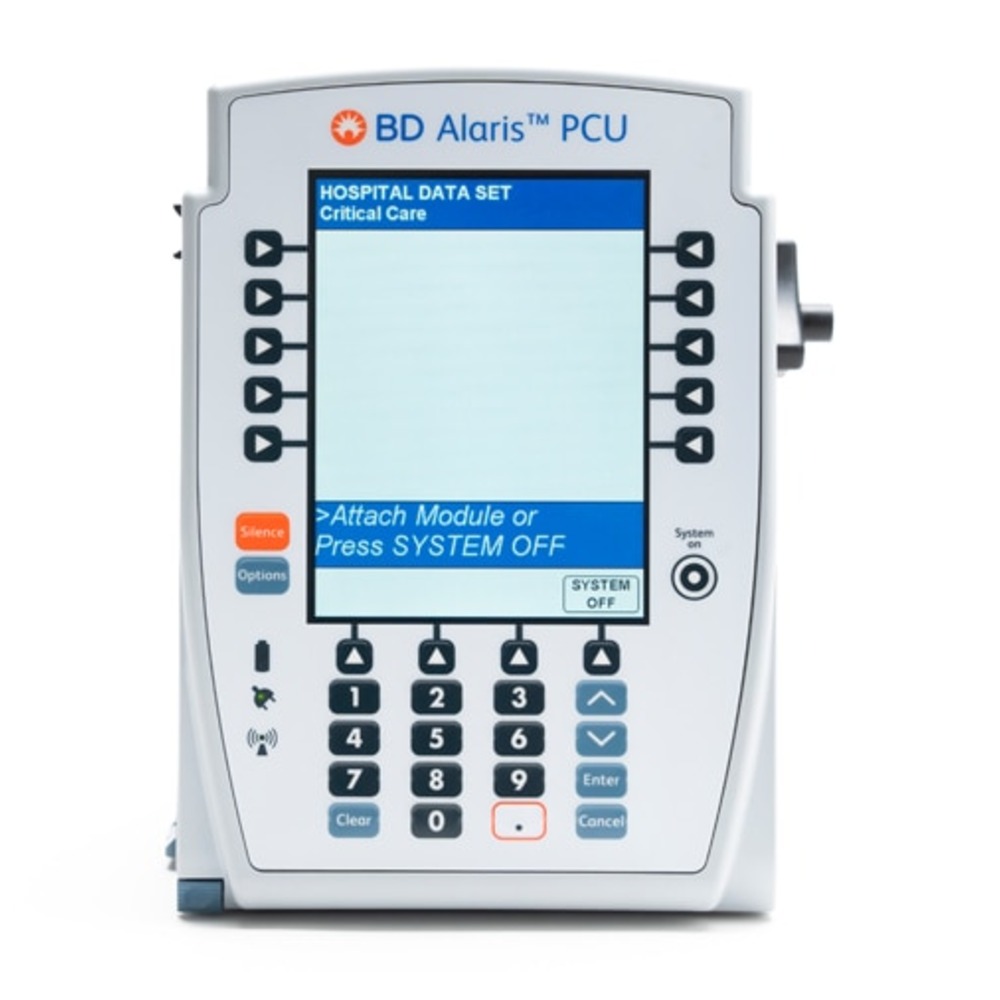
BD Alaris 8015 PC Unit (v12.3 Software)
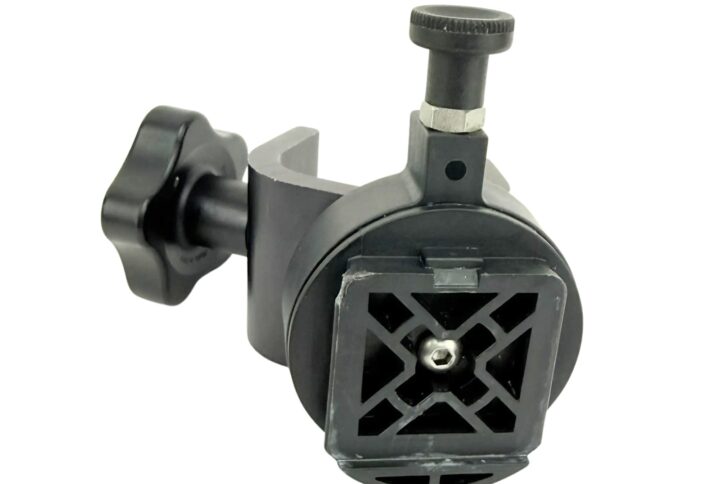
The BD Alaris 8015 PC Unit with v12.3 software is the newer generation of the brain behind the Alaris modular infusion system. Like every 8015, it doesn’t deliver medication on its own — it’s the command center. Attach up to four Alaris infusion and monitoring modules (pump, syringe, PCA, EtCO2) plus Auto-ID to a single PCU, and it gives every one of them a unified color interface, a shared Guardrails drug library, and one place to program, monitor, and alarm. What’s different is underneath: this unit is built on BD Alaris hardware, with a redesigned front case and keypad, battery pack, rear case, one-piece pole clamp, and 802.11 a/b/g/n wireless card that BD lists as not interchangeable with older Alaris parts.
For biomed and IT teams, v12.3 is the system release BD recommended customers move to in 2023, and this PCU pairs with BD Alaris Systems Manager and System Maintenance v12.3. If your fleet is standardized on v12.3, a recertified unit that already matches drops in without mixing software generations. Note that v12 software does not support the Alaris SpO2 modules.
Also available: BD Alaris 8015 with 5.7″ display and BD Alaris 8015 with 4.7″ display (earlier software)
If your staff has used any Alaris 8015, they’ll recognize the workflow instantly. IPR Medical buys, sells, repairs, and stocks parts for the BD Alaris 8015. Call us at 855-477-8866 or email cs@iprmed.com.
BD Alaris 8015 PC Unit (v12.3 Software) — Specifications
| Manufacturer | BD (Becton, Dickinson and Company) / CareFusion |
| Model | BD Alaris PC Unit, Model 8015 (BD Alaris-generation hardware, 5.7″ display) |
| Software Compatibility | PCU software v12.3 (BD Alaris System v12.3; the FDA GUDID lists this PCU release as v12.3.1) with Guardrails Suite MX and Guardrails Point-of-Care software. Pairs with Guardrails Editor 12.1.3 and BD Alaris Systems Manager and System Maintenance v12.3; not compatible with Guardrails CQI Reporter v10.17 or earlier |
| Intended Use | Modular infusion pump and monitoring system for the controlled delivery of fluids, medications, blood, and blood products by healthcare professionals; intended for adult, pediatric, and neonatal patients |
| Infusion Routes | Intravenous (IV), intra-arterial (IA), subcutaneous, epidural, irrigation of fluid spaces (route determined by attached module) |
| Display | 5.7″ full-color LCD |
| Compatible Modules | Up to 4 infusion/monitoring modules: Pump Module 8100, Syringe Module 8110, PCA Module 8120 (one PCA Module functions per system), EtCO2 Module 8300; Auto-ID Module 8600 attaches in addition. Alaris SpO2 Modules 8210/8220 are not supported (BD removed SpO2 compatibility beginning with PCU software v12.1.2) |
| Guardrails Drug Library | Up to 30 patient-specific care area profiles (Profiles); each profile contains a Drug Library, IV Fluid library, and instrument configurations; soft and hard dose limits per drug entry; data sets built in Guardrails Editor 12.1.3 |
| EMR Interoperability | Pump and Syringe Modules can receive infusion order parameters from the facility’s EMR/HIS for pre-population and publish infusion status (requires a BD Alaris interoperability implementation with Systems Manager) |
| Data Set / Library Transfer | Via wireless network (BD Alaris Systems Manager); RS-232 serial port (RJ45 connector) |
| Wireless Connectivity | 802.11 a/b/g/n wireless network card (BD Alaris-specific kit); link speed up to 72 Mbps |
| BD Alaris-Specific Hardware | Front case/keypad assembly, NiMH battery pack, rear case assembly, 802.11 a/b/g/n wireless card kit, one-piece pole clamp, handle kit, rear-case gasket kit, power cord retainer, and RJ45 port plug; BD lists these parts as not interchangeable with older Alaris parts |
| Battery | 12V, 4000 mAh Nickel-Metal Hydride (NiMH), 10-cell, rated for a minimum of 500 charge cycles; charges whenever connected to AC; typical life ~2 years under normal use and maintenance |
| Battery Runtime (typical, new battery) | 6 hrs (1 pump module at 25 ml/h); 3 hrs (4 pump modules at 25 ml/h); 1 hr (4 pump modules at 999 ml/h plus Auto-ID); 6 hrs (1 syringe or PCA module at 5 ml/h); 3 hrs (4 syringe modules, or 1 PCA + 3 syringe modules, at 5 ml/h); 4 hrs (1 EtCO2 module) |
| AC Power | 100 – 240 VAC, 50/60 Hz, 150 VA max; battery switches over automatically if AC power is interrupted; power cord included |
| Communication Data Port | RS-232 with RJ45 connector |
| Memory | 16 MB on-board flash: boot and application code, CQI, event, error, and battery logs (nonvolatile); 64 MB CompactFlash: audio tones, Data Set, restorable patient data (nonvolatile); 128 MB SDRAM; module parameters retained 8 hrs after power-off |
| Electric Classification | Class I, Internally Powered Equipment; Type CF defibrillator-proof rating applies when defibrillation-proof modules are attached |
| Fluid Ingress Protection | IPX2 (Drip Proof) |
| Operating Environment | 41 – 104°F; 20 – 90% relative humidity (noncondensing); 525 – 795 mmHg |
| Storage / Transport | −4 – 140°F; 5 – 90% relative humidity (noncondensing); 375 – 760 mmHg |
| Mode of Operation | Continuous |
| Equipment Orientation | Must remain upright during operation |
| Pole Clamp | Fits poles 5/8″ to 1-3/8″ in diameter; vertical (IV pole) or horizontal (bed rail) mounting |
| Dimensions | 8.8″ H × 8.1″ W × 8.8″ D (22.4 cm × 20.6 cm × 22.4 cm), including pole clamp |
| Weight | 8.2 lbs (3.7 kg), including pole clamp and power cord; max system weight 28.3 lbs (PCU, 3 syringe modules, 1 PCA module, 1 Auto-ID module) |
| MRI Safety | MR Unsafe |
| Service Life and Maintenance | BD-tested 7-year serviceable life; preventive maintenance inspection once a year; battery conditioning every 12 months |
| FDA 510(k) | K211218, BD Alaris System with Guardrails Suite MX v12 (cleared July 21, 2023) |
| Purchase Scope | Includes: one recertified BD Alaris 8015 PC Unit with v12.3 software, pole clamp, and power cord. Not included: infusion or monitoring modules, administration sets or syringes, your facility’s Guardrails data set, and BD software licenses (Systems Manager, Guardrails Editor, System Maintenance, CQI Reporter) |
| FDA Device Corrections | Multiple FDA corrections and safety notices on record that include the v12.3.1 PCU (2023–2026) — see the Description tab and contact IPR Medical at 855-477-8866 for current guidance |
IPR Medical buys, sells, repairs, and stocks parts for the BD Alaris 8015 PC Unit. Contact us at 855-477-8866 or cs@iprmed.com.
Trademark Notice: BD, and all other brand names, model names, and part numbers shown are trademarks of their respective owners and are used on this page only to identify the original manufacturer’s equipment offered here, consistent with nominative fair use. This listing is offered by IPR Medical, an ISO 9001:2015-certified independent service organization, and is not sponsored by, affiliated with, or endorsed by BD.
Quick answer: The BD Alaris 8015 PC Unit with v12.3 software is the controller of the Alaris modular infusion system, built on BD Alaris-generation hardware and running PCU software v12.3. It runs up to four pump, syringe, PCA, and EtCO2 modules (plus Auto-ID) through one color interface and Guardrails Suite MX, and it pairs with BD Alaris Systems Manager and System Maintenance v12.3. It does not support the Alaris SpO2 modules. IPR Medical sells recertified v12.3 units backed by IPR Medical’s warranty, repairs them in-house, and stocks replacement parts.
Overview
The BD Alaris 8015 PC Unit is the central controller — the “brain” — of the Alaris modular infusion system. It doesn’t infuse on its own. It provides the color display, keypad, Guardrails drug library, alarms, battery, and wireless link for every module attached to it. This listing is specifically for PCUs built on BD Alaris-generation hardware and running v12.3 software. In July 2023 the FDA cleared the updated BD Alaris System with Guardrails Suite MX v12 under 510(k) K211218; BD described the clearance as covering updated PCU hardware, new software with cybersecurity enhancements, and interoperability with widely used electronic medical record systems. BD then recommended that customers update to BD Alaris System v12.3 where available based on regulatory authorization, and released PCU software v12.3.1 alongside it. If your facility has standardized on v12.3, buying a unit that already matches keeps one software generation across the fleet.
How the v12.3 Unit Differs from Earlier 8015 PC Units
The model number is still 8015, but the internals and software are not the same as the Alaris PCUs on our 5.7″ and 4.7″ listings. Earlier units use the original Alaris front case and keypad, battery pack, rear case, and C-clamp pole clamp; this unit uses BD Alaris-generation versions of those parts, plus a one-piece pole clamp and an 802.11 a/b/g/n wireless card kit. BD’s technical service manual identifies the BD Alaris front case/keypad assembly, NiMH battery pack, rear case assembly, wireless card kit, pole clamp, handle kit, rear-case gasket kit, power cord retainer, and RJ45 port plug as not interchangeable with older parts — so spares stocked for an older Alaris PCU won’t necessarily fit this one. BD’s v12 labeling also rates the system IPX2 (drip proof), up from IPX1 on earlier labeling. Earlier PCUs run software that varies by unit and, before v12.1.2, could support the SpO2 modules; this unit runs v12.3 and does not.
What Changed in v12 Software
Staff moving from older Alaris software should know about several workflow changes BD made in the v12 releases before go-live. The PCU now clearly flags infusions programmed in Basic Infusion mode without Guardrails protection, with an optional clinical advisory. The Multidose option is not available on PCU software v12.x, and delayed starts no longer offer a “Delay Until” time selection; instead, a callback alert can be set before an infusion starts, after it completes, or both. Infusion Complete and Infusion Complete – KVO alarms on the pump and syringe modules moved from medium to high priority, two additional air-in-line thresholds (125 and 175 mcL) are available, and a two-screen Guardrails alert appears when a custom concentration is programmed on a pump, syringe, or PCA module.
Guardrails Suite MX, Drug Library, and Interoperability
The v12.3 PCU runs Guardrails Suite MX, BD’s medication error prevention software, which supports up to 30 patient-specific care area profiles. Each profile carries its own Drug Library, IV Fluid library, and instrument configuration settings, with Hard Limits that cannot be overridden during programming and Soft Limits that can be overridden with clinical confirmation. With v12.3, Data Sets are built in Guardrails Editor 12.1.3 and transferred to each PCU wirelessly through BD Alaris Systems Manager or by cable through the RS-232 data port. BD notes that System v12.3 is no longer compatible with Guardrails CQI Reporter v10.17 or earlier, so plan reporting tools accordingly. For facilities with BD Alaris interoperability in place, the pump and syringe modules can receive infusion orders from the EMR/HIS for pre-population and publish infusion status back to it; clinicians can still program manually at any time, and Guardrails limits apply to every rate change.
Modular Architecture and Compatible Modules
The v12.3 PCU accepts up to four infusion or monitoring modules attached to either side of the unit or daisy-chained from one another, plus the Auto-ID Module. Compatible modules include the Alaris Pump Module 8100 (large-volume), Syringe Module 8110, PCA Module 8120, and EtCO2 Module 8300; only one PCA Module functions as a PCA per system. BD removed Alaris SpO2 Module (8210/8220) compatibility beginning with PCU software v12.1.2, so SpO2 monitoring is not available on this unit. BD pairs each PCU software release with matching module and support-software versions — tell us what your fleet runs and we’ll confirm fit before you order.
Wireless Connectivity and Fleet Management
The v12.3 PCU uses an 802.11 a/b/g/n wireless network card from BD’s BD Alaris-specific kit, with link speeds up to 72 Mbps. When connected, it works with BD Alaris Systems Manager to push updated Data Sets to the fleet and pull event and CQI logs for centralized review. If your network uses enterprise-level Wi-Fi security, confirm which TLS versions your PCUs require before deployment (see the February 2026 correction below). BD also recommends compensating controls such as placing Alaris PCUs on their own network segment.
Battery and Power
The v12.3 PCU is powered by a 12V, 4000 mAh Nickel-Metal Hydride (NiMH) battery that charges whenever the unit is connected to AC power and switches over automatically if AC power is interrupted. With a new, fully charged battery, a single pump module infusing at 25 ml/h runs approximately 6 hours; four pump modules at 25 ml/h run approximately 3 hours. Syringe and PCA configurations at 5 ml/h deliver similar runtimes, and a single EtCO2 module runs approximately 4 hours. BD rates the pack for at least 500 charge cycles, expects about 2 years of battery life under normal use and maintenance, and calls for battery conditioning every 12 months.
FDA Device Corrections and Safety Bulletins
The BD Alaris System — including the 8015 PC Unit — has been subject to FDA recalls, device corrections, and safety notices since 2020. The actions below were initiated from 2023 onward and list the BD Alaris PCU Model 8015; several list the v12.3.1 PCU (UDI-DI 10885403516023) among affected devices. Facilities should verify current software versions and review open notices with their biomedical engineering, pharmacy, and IT teams.
1. Class 2 Correction (February 2026, Z-1645-2026) — Wi-Fi TLS Labeling: BD’s labeling did not state which Transport Layer Security (TLS) versions must be enabled on the hospital network for secure Wi-Fi communication with Alaris and BD Alaris PCUs under enterprise-level security. If TLS 1.0 is disabled, PCUs may fail to connect and a memory leak can lead to a System Error. BD instructs users to watch the PCU’s wireless indicator, follow wireless-downtime protocols if it is not lit, power-cycle the PCU and reprogram any active infusion after a System Error, and have IT confirm which TLS versions must remain enabled.
2. Class I Infusion Set Recall (2025–2026) — BD Alaris Pump Infusion Sets: Starting in July 2025, BD notified customers that some compatible infusion sets may perform outside user-manual ranges for flow rate and bolus accuracy, occlusion time to alarm, and post-occlusion bolus volume when used with the BD Alaris Pump Module 8100, most notably at low rates. The FDA classified the action as Class I and, as of its October 2026 update, lists Guardrails Suite MX software up to v12.6. On August 19, 2026, BD directed customers to discard the sets on its discontinued list and to prioritize alternate sets for critical-care, neonatal, infant, and pediatric areas. BD’s mitigations, drawn from the v12.3–v12.6 user manual, include keeping the fluid container no more than 21 inches above the top of the pump module.
3. Class 1 Correction (February 2025, Z-1304-2025) — BD Alaris Systems Manager: BD Alaris Systems Manager software v12.5.2 and earlier, including v12.3, may send an outdated automated programming request to the PCU. BD instructs clinicians to verify every pre-populated infusion parameter before pressing START.
4. Class 2 Correction (August 2024, Z-3138-2024) — IUI Connectors: BD identified an increase in bent contacts on the new female (left) IUI connectors, which can prevent a module from operating and delay the start of an infusion or monitoring. The FDA records list specific serial numbers for the PCU 8015 and for the pump, syringe, PCA, and EtCO2 modules. BD instructs users to inspect all IUI connectors before use and to send any device with a bent or lifted pin to biomedical engineering or qualified service personnel.
5. Class 1 Labeling Correction (September 2023, Z-0184-2024) — Syringe Compatibility: The compatible-syringe lists for the Alaris Syringe and PCA Modules included syringes that had not been validated, and the FDA record lists the BD Alaris PCU (REF 8015). Facilities were told to stop using Cardinal Health Monoject syringes with the Alaris Syringe and PCA Modules, except SKU 8881135609, and to replace their compatibility lists.
6. Cybersecurity Bulletins (2023): CISA advisory ICSMA-23-194-01 covers BD Alaris PCU software v12.1.3 and earlier. BD’s v12.3 system release remediated or reduced several of the advisory’s vulnerabilities in the system’s supporting software, such as Guardrails Editor, and BD updated the PCU to v12.3.1 at the same time. BD states that three PCU-level vulnerabilities (CVE-2023-30559, CVE-2023-30560, and CVE-2023-30561) remain present in PCU v12.3.1 and recommends compensating controls, such as placing Alaris PCUs on their own network segment. BD reported no known exploitation of the 2023 vulnerabilities in any customer environment or clinical setting.
Action recommended: Facilities operating BD Alaris 8015 PCUs should verify the installed software version on each unit, review open BD notices with their biomedical engineering, pharmacy, and IT teams, and follow BD’s current instructions. IPR Medical can assist with parts and service — call 855-477-8866 or email cs@iprmed.com.
Because FDA device corrections and safety communications may be updated or expanded after the date of this listing, IPR Medical recommends that facilities also check the FDA’s official resources directly to ensure they have the most current information:
- FDA Medical Device Recalls Database
- FDA Medical Device Safety
- FDA MedWatch
- CISA Advisory ICSMA-23-194-01 — BD Alaris System
- BD Cybersecurity Bulletin — BD Alaris System with Guardrails Suite MX
IPR Medical — Your Source for the BD Alaris 8015 v12.3
IPR Medical buys, sells, repairs, and stocks parts for the BD Alaris 8015 PC Unit, including BD Alaris-generation units on v12.3. Whether you are filling out a v12.3 fleet, need a recertified unit or replacement component, or want service support for PCUs you already own, our team can help you match hardware and software to what your facility runs.
IPR Medical buys, sells, repairs, and stocks parts for the BD Alaris 8015 PC Unit. Contact us at 855-477-8866 or cs@iprmed.com.
Frequently asked questions
How is the v12.3 unit different from your other Alaris 8015 PC Units?
This unit is built on BD Alaris-generation hardware and runs PCU software v12.3. Our 5.7-inch and 4.7-inch listings are earlier Alaris-generation PCUs on earlier software. The v12.3 unit has an IPX2 drip-proof rating, an 802.11 a/b/g/n wireless card, several parts that are not interchangeable with older PCUs, and it matches BD’s v12.3 system software. It does not support SpO2 modules.
Can I run v12.3 PCUs alongside older Alaris PCUs?
BD pairs each PCU software release with matching module software, Guardrails Editor, Systems Manager, and System Maintenance versions, and v12 software removes some features older releases had, including Multidose, Delay Until, and SpO2 support. Most facilities keep one release across the fleet. Tell us what your fleet runs and we will confirm fit before you order.
Is v12.3 the newest Alaris software?
No. The FDA’s GUDID database also lists a BD Alaris PCU Model 8015 with software v12.4.0, and the FDA’s October 2026 update to BD’s infusion set recall covers Guardrails Suite MX software up to v12.6. This listing is specifically for v12.3. If your facility needs a different release, call us.
How long does the Alaris 8015 v12.3 battery last?
The 12V, 4000 mAh NiMH battery charges whenever the unit is on AC power. With one pump module at 25 ml/h, a new battery runs about 6 hours; with four modules, about 3 hours. An EtCO2 module runs about 4 hours. Expected battery life is about 2 years, and BD calls for battery conditioning every 12 months.
Does the v12.3 PC Unit work with the Alaris SpO2 module?
No. BD removed Alaris SpO2 Module (8210/8220) compatibility beginning with PCU software v12.1.2.
Can IPR Medical help with our Guardrails data set?
Questions about Guardrails Suite MX data sets, drug libraries, or BD Alaris Systems Manager should go directly to our team. Call IPR Medical at (855) 477-8866 or email cs@iprmed.com, Monday through Friday, 7:00 AM to 4:30 PM Pacific, and we will talk through your Alaris fleet.
Can IPR Medical repair our Alaris PC Units?
Yes. IPR Medical repairs BD Alaris PC Units in-house. U.S. customers can request a free inbound FedEx or UPS shipping label through our RMA form, receive a free evaluation within 1 to 2 business days, and approve a written estimate before work begins. Repaired units are tested to OEM specifications, cleaned, and carry a 90-day warranty.
Repair service: IPR Medical also repairs BD Alaris pumps in house, with a free shipping label, a free evaluation and a 90-day repair warranty. See BD Alaris pump repair.
Trademark Notice: BD, and all other brand names, model names, and part numbers shown are trademarks of their respective owners and are used on this page only to identify the original manufacturer’s equipment offered here, consistent with nominative fair use. This listing is offered by IPR Medical, an ISO 9001:2015-certified independent service organization, and is not sponsored by, affiliated with, or endorsed by BD.
| Weight | 8.2 lbs |
|---|---|
| Dimensions | 14 × 14 × 14 in |
| Condition | Recertified (Refurbished) |
You may also like…


Alaris BD 8110 Syringe Pump Module
Original price was: $1,895.00.$1,495.00Current price is: $1,495.00.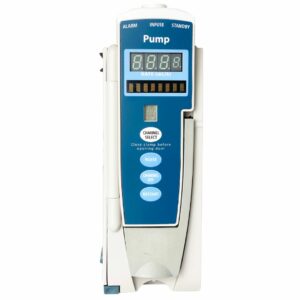
Alaris 8100 Pump Module
Original price was: $895.00.$495.00Current price is: $495.00.Related Products


B Braun Infusomat Space Version U
Original price was: $1,495.00.$995.00Current price is: $995.00.
ICU Medical/ Hospira Plum 360
Original price was: $1,995.00.$1,150.00Current price is: $1,150.00.
Reviews
There are no reviews yet.